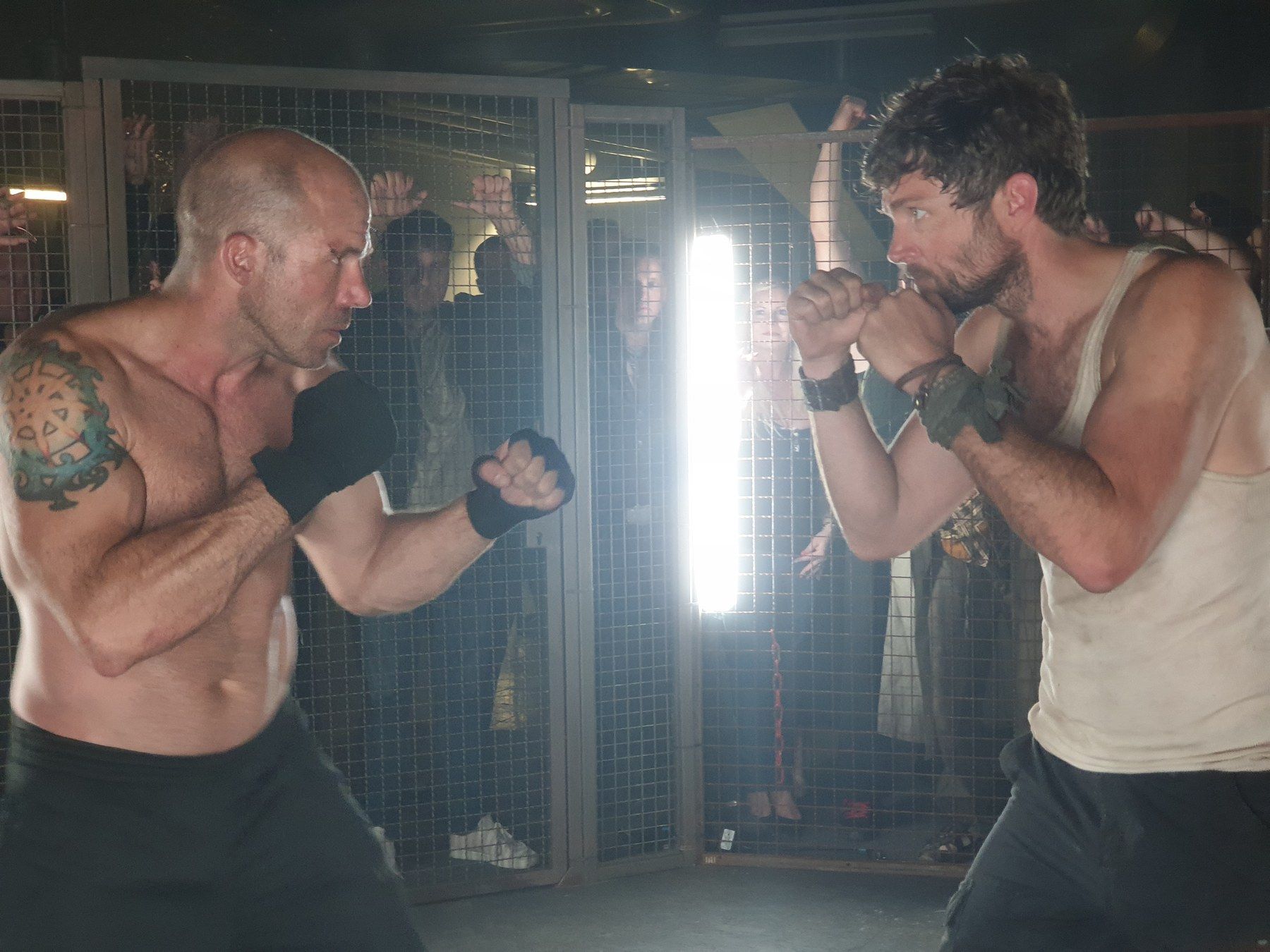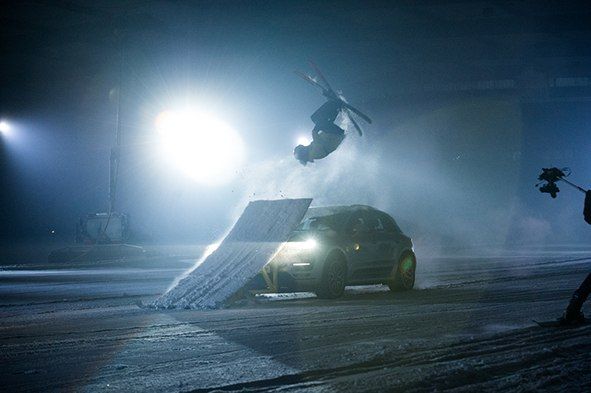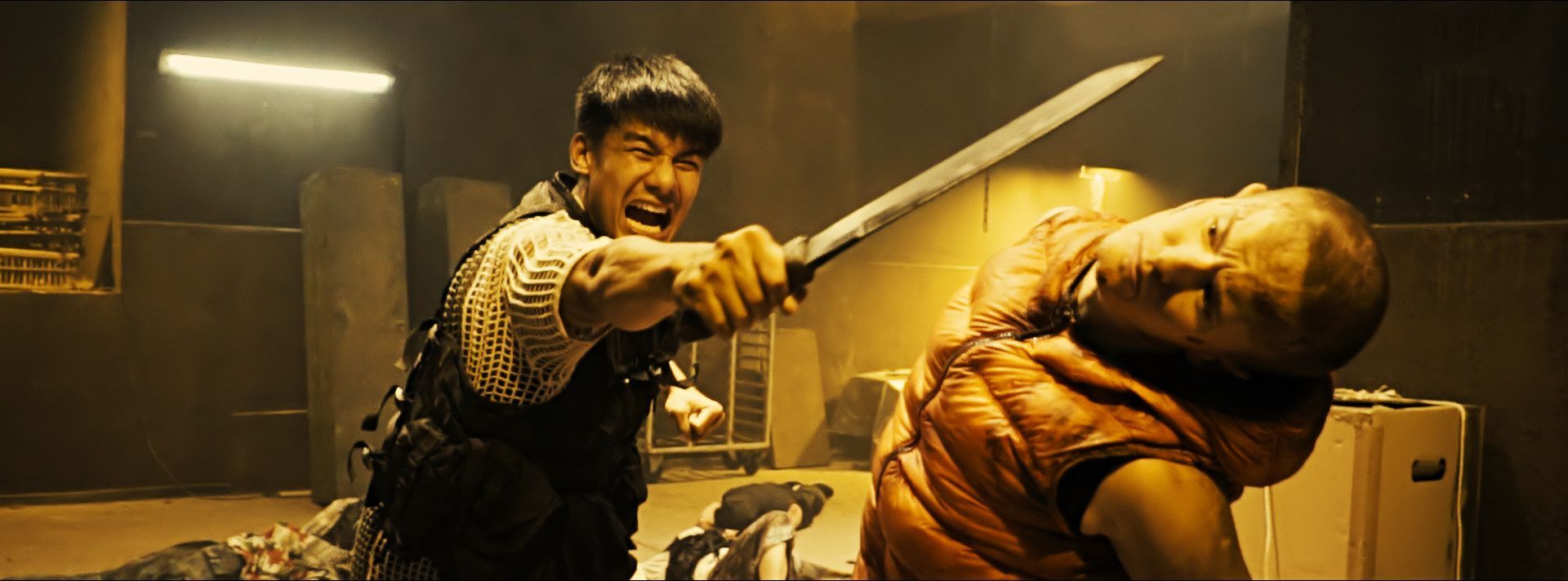
One creative lead. A complete camera ecosystem. The freedom to follow the shot.
On Fast X , Ferdi Fischer led a Floating Action Unit that connected shot design, camera development and physical execution inside one mobile team. Its work reached from the air above Rome to the road beneath a moving convoy, from motorcycle pursuit to the production’s close-action A-camera assignments. Each position served a specific image, story beat or practical production need.
Ferdi developed shots, coordinated the people making them and operated cameras himself. When a planned image required a different physical solution, he could develop that solution within the WarpCam® ecosystem. When another unit needed him, the crew could move. When his FPV team was working from an established brief, he could step away to operate A-camera.
Fast X brought this approach to a substantially greater scale: approximately seven people, including assistants and camera support, working across multiple camera platforms under Ferdi’s leadership. The result was an unmatched combination of creative responsibility, proprietary camera engineering and autonomous action coverage.
The trailer outcome: all of Ferdi Fischer’s A-camera shots appear in the Fast X trailers, and the trailers include every operating area of his Floating Action Unit. The making-of material below connects that outcome to the decisions, systems and people behind the images.
The complete WarpCam® / making-of comparison
Watch the full 72-second production film, then follow the chapters into the decisions behind the images.
FERDI’S REMIT
Develop the shot.
Build its solution.
Lead its execution.
Shot design and direction
Head of Floating Action Unit
WarpCam® inventor and operator
A-camera operator
Explore the full comparison
Choose a moment in the complete film.
00:21 Motorcycle 00:32 Ground pole 00:36 RC story 00:44 Bus interior 00:48 Riverside car 00:53 Staircase 00:59 Gimbal FPV 01:04 Humvee roll 01:08 Collision coverageThe existing production compilation places camera images beside the set. Some images are production previews before final effects.
Full source ↗Follow the production problem through to the image
This case study follows the decisions behind the footage. Start with the complete split-screen film above: it places the camera image beside the work that produced it. Then follow the individual examples through six questions: What did the sequence need? What made that difficult? What did Ferdi decide? Which camera configuration and people delivered it? What can be seen in the production material? What did the production gain?
The final step is the official trailer section. Across the Fast X trailers, all of Ferdi Fischer’s A-camera shots are represented, and every operating area of his Floating Action Unit appears: Sony VENICE A-camera, gimbal FPV with Johnny FPV, WarpCam® handheld and motorcycle work, vehicle hard mounts and RC camera coverage. The trailers show the work in the film’s public presentation after the preceding chapters explain how it was made.
Each route leads back to the same complete case. The production benefit comes from the connection between the decisions: shot development informed camera development; the camera systems enabled different positions; a prepared crew could execute one assignment while Ferdi undertook another; and the complete unit could move when the production changed its priorities.
All chapters in this case study
- The complete assignment
- Follow the production problem through to the image
- The assignment reached across the action
- What made the unit “floating”
- The camera systems, and the job each one performed
- Matching the production’s image
- One lead connected the creative and technical decisions
- How to read the production footage
- The café image: designing the whole frame
- A camera system developed because the story needed it
- Johnny FPV, WarpCam® and an independently controlled frame
- Taking the production’s A-camera into the action
- Handheld, on the pole and on the motorcycle
- The staircase shot that the Floating Action Unit delivered
- Giving the sequence its place
- Under five minutes to move. Under five minutes to shoot.
- What productions can recognise in this case
- Ten production problems and the corresponding Fast X solutions
- Turn the production problem into a useful brief
- What Fast X demonstrates
- Questions producers, directors and DOPs can answer from Fast X
- From the set to the official Fast X trailers
- Ferdi Fischer’s Floating Action Unit for Fast X
The assignment reached across the action
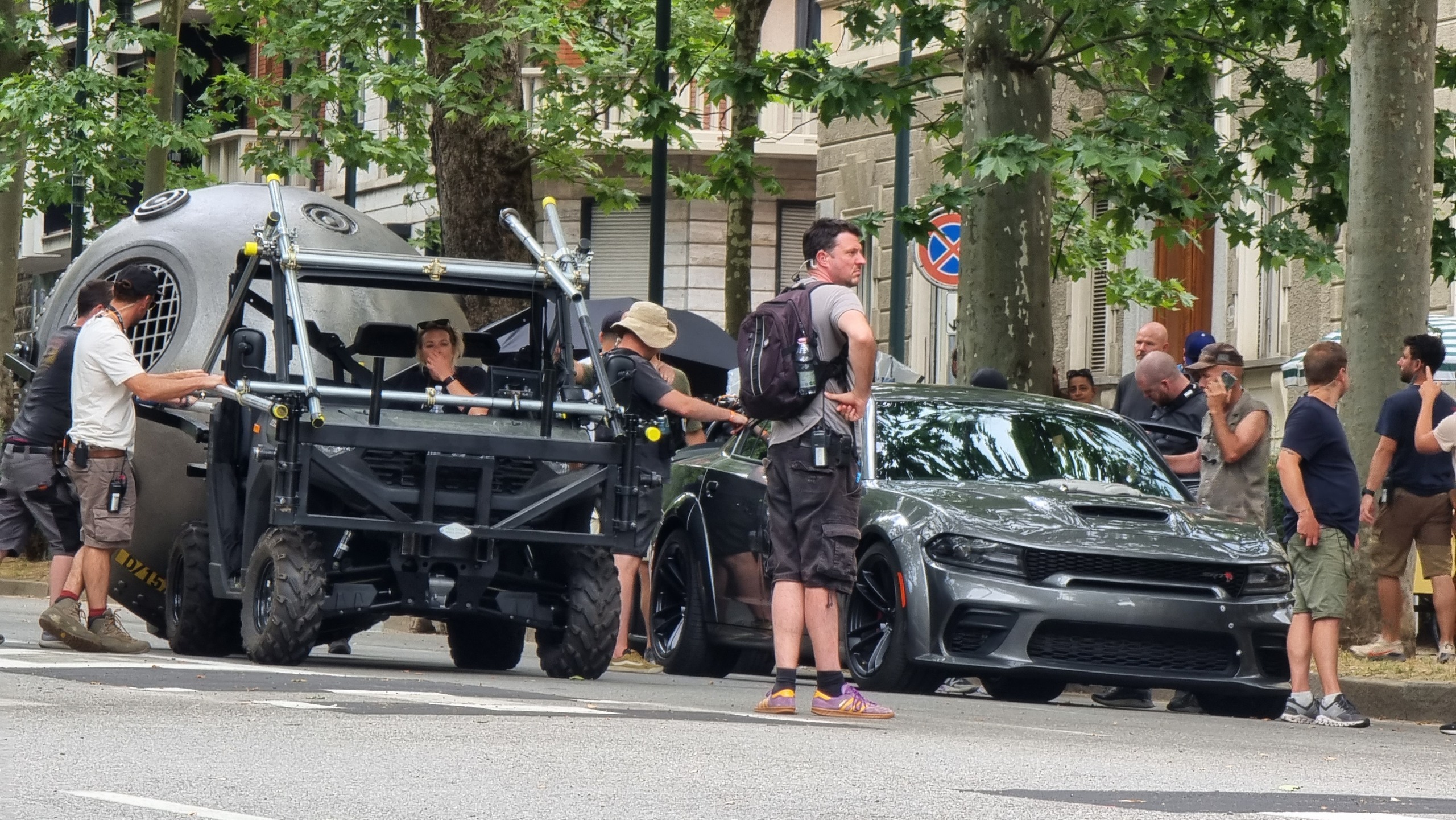
The brief began with several responsibilities running together. WarpCam® would work handheld, on a pole and hard-mounted to vehicles. Johnny FPV would join Ferdi’s team to fly the gimbal-equipped camera. A separate development task, discussed with the DOP before shooting, called for a specially adapted RC camera car. Ferdi also took on demanding A-camera operating assignments using the production’s own camera.
These functions connected camera, grip, engineering and stunt knowledge. The same conversation could begin with the image the story needed, move into the physical route of the camera, and end with a decision about the system and people required to capture it.
| Responsibility | Fast X application |
|---|---|
| Shot design and direction | Developing camera movements, compositions and additional shots across the set. |
| Floating Action Unit leadership | Coordinating operators, FPV, focus and camera support between assignments. |
| Camera engineering | Creating the low RC configuration around a specific narrative requirement. |
| WarpCam® operating | Handheld, pole, vehicle, motorcycle and close-action camera positions. |
| Gimbal FPV coordination | Integrating Johnny FPV’s flying with independent cinematic framing. |
| A-camera operating | Operating the production camera on especially demanding action shots. |
What made the unit “floating”
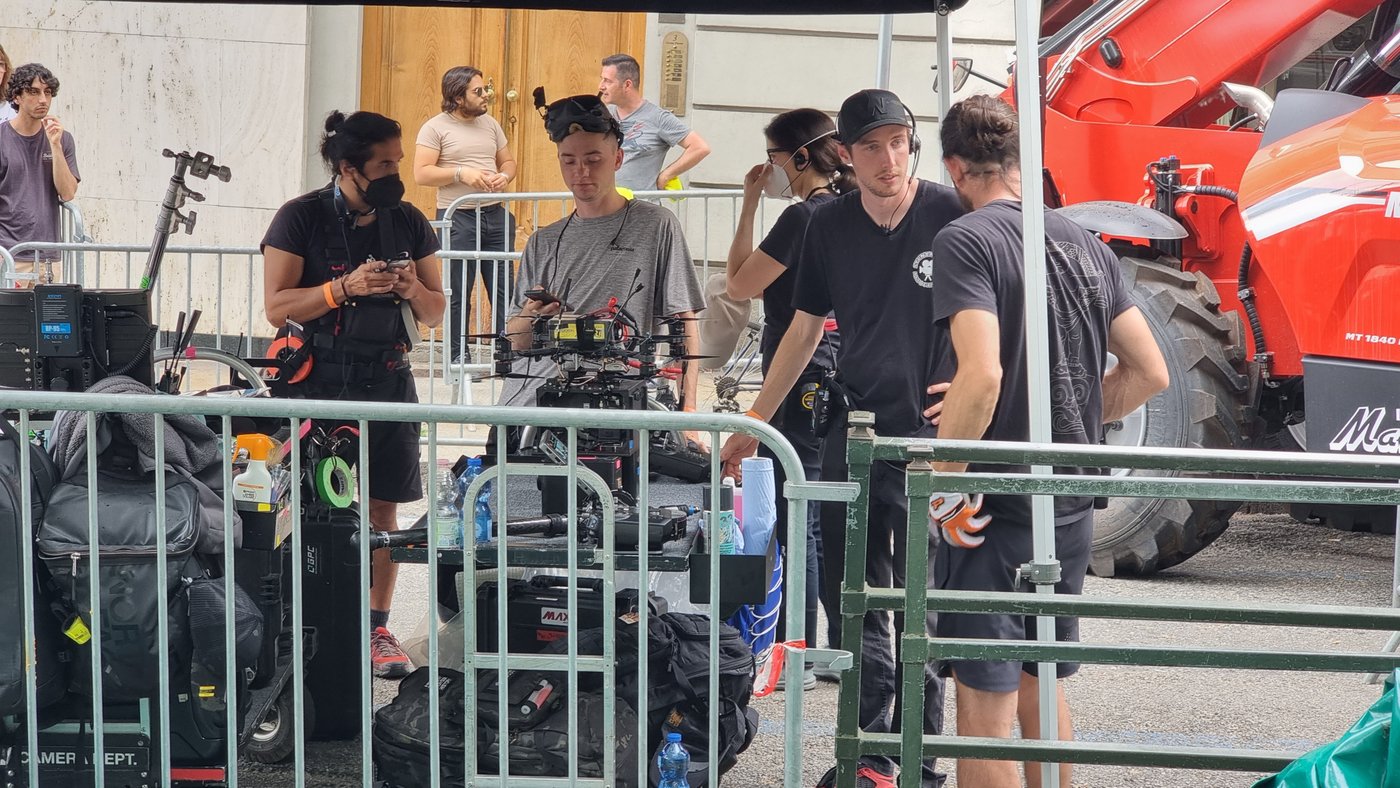
The team was primarily attached to the film’s extensive Second Unit. On this production, that operation was larger than the First Unit and included further splinter units working on different parts of the action. Ferdi’s crew could support those assignments and move to Third Unit when required.
The director repeatedly gave the Floating Action Unit the freedom to move across the set and develop the strongest shots Ferdi could find. That freedom placed creative responsibility with him. He had to recognise a useful image, understand how it fitted the action and organise the people and equipment to deliver it.
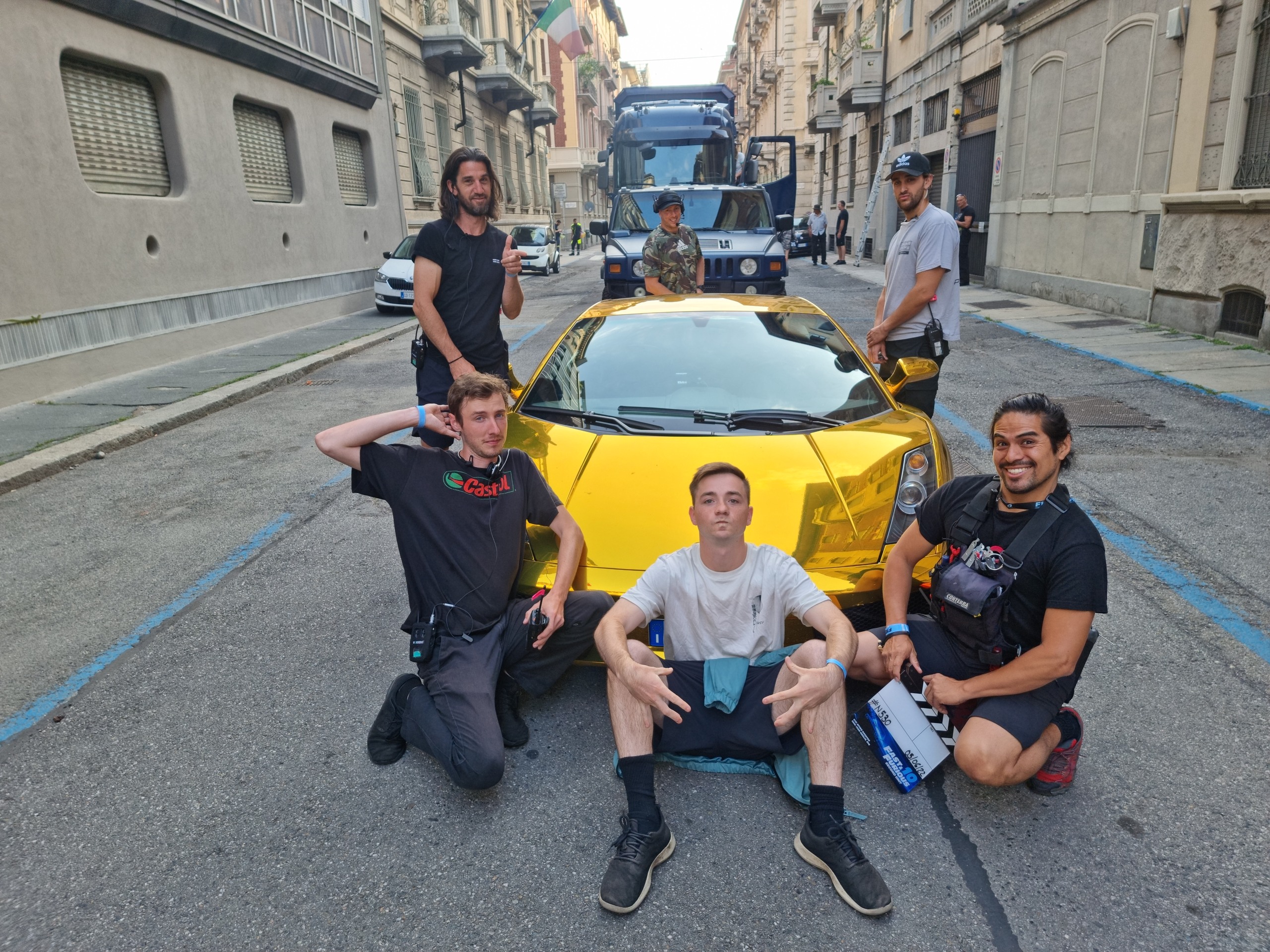
Within the team, physical operating, virtual camera operating, focus, camera preparation and FPV formed a shared working method. The person moving a camera through space and the person controlling its frame could have separate tasks while pursuing the same shot. Ferdi led that coordination.
“Floating” described this ability to change assignments while retaining a complete working team. The unit carried its camera knowledge, equipment and creative understanding with it. Its place in the production followed the needs of the sequence.
The camera systems, and the job each one performed
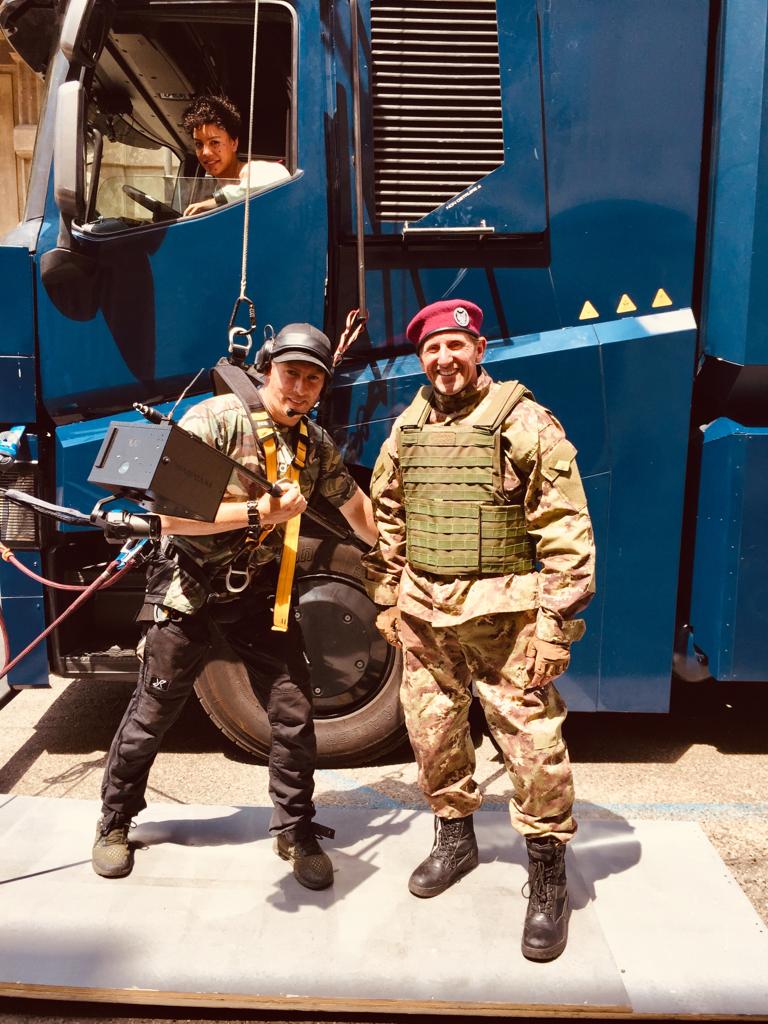
The Fast X assignment used a family of camera configurations around the needs of individual shots. WarpCam® was the core camera system that Ferdi could take into several physical positions. The carrier determined where the camera could travel. The operator determined how the image developed. The Floating Action Unit brought the system, its preparation and those operating roles together.
Ferdi’s work with the production’s Sony VENICE belonged to a further part of his remit: personally operating the A-camera for demanding action positions. This sits alongside his WarpCam® development and unit leadership in the case study. Keeping those responsibilities explicit makes the scope of his contribution clear.
| Configuration | Job on Fast X | Operating relationship | Where to see it |
|---|---|---|---|
| WarpCam® handheld | Place a compact, stabilised camera close to the action and let the physical operator shape its route through the scene. | Physical camera movement works with framing and focus. Ferdi’s understanding of the action informs the camera position and timing. | Physical camera work; the complete comparison film; official trailers. |
| WarpCam® on a pole | Extend the camera’s position beyond the operator’s hands and reach viewpoints required by the action. | The physical operator moves the pole and camera through space. Remote framing can be controlled separately within the team. | Ground pole comparison; staircase recovery. |
| WarpCam® hard-mounted to vehicles | Establish camera positions attached to a vehicle, including interior and exterior assignments and hard mounts on a motorcycle. | The vehicle carries the camera position as part of the action. Camera preparation and the intended frame belong to the shot brief. | Vehicle configurations; the operating range documented in this case and the official trailers. |
| Handheld camera from a motorcycle passenger position | Deliver leading and following images while travelling with motorcycle action. | The camera vehicle supplies the movement; Ferdi operates from its passenger position. The shot brings the camera into the rhythm of the pursuit. | Motorcycle comparison, with the camera vehicle visible in the making-of image. |
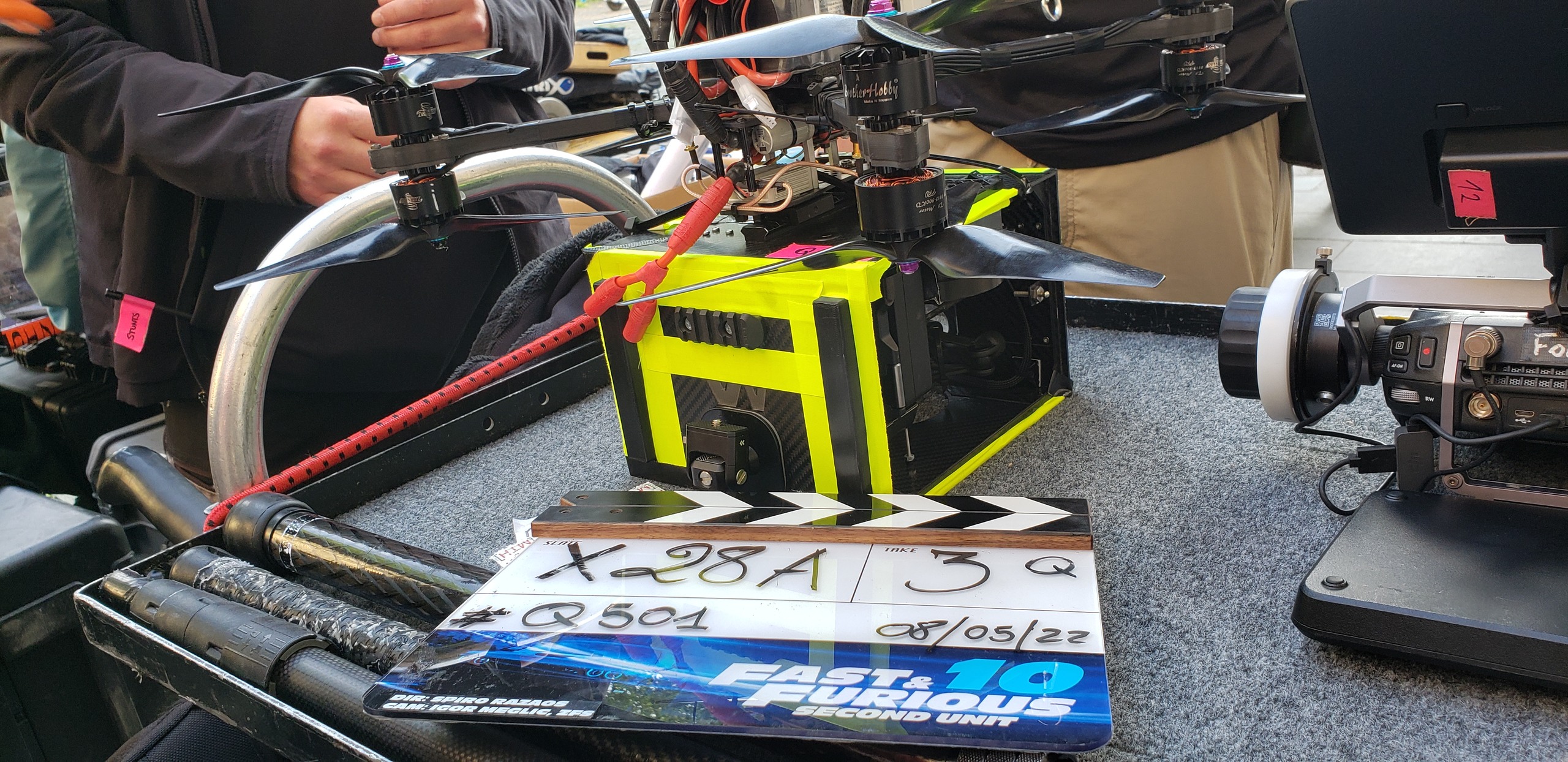
| WarpCam® gimbal FPV | Give an aerial camera the path required by the action while allowing its composition to be controlled independently. | Johnny FPV flies within Ferdi’s Floating Action Unit. Camera operating and focus form coordinated responsibilities around the flight. | Gimbal FPV chapter, the aircraft-and-result comparison and Johnny’s Fast X release. |
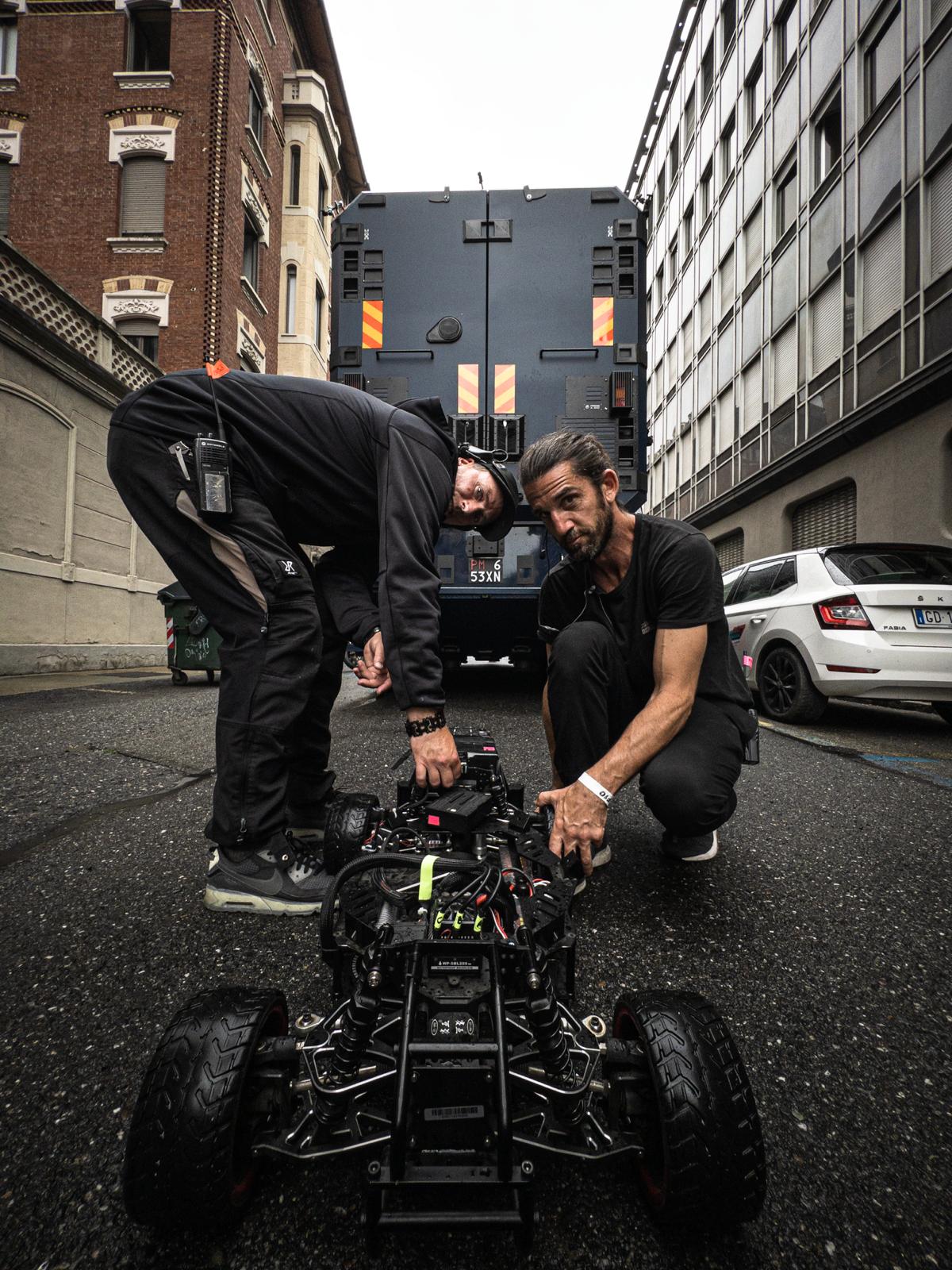
| Purpose-built WarpCam® RC camera car | Photograph the story’s small RC vehicle at its own level, including the space beneath the convoy. | One vehicle performs the fictional action. A separate stabilised camera vehicle follows, leads or travels alongside it. | RC development chapter, original platform photographs and the short comparison. |
| Sony VENICE 2 with detached sensor head / Rialto | Allow Ferdi to operate the production’s A-camera in close-action assignments. | The lens and sensor head can be handled separately from the camera body. Ferdi combines camera operating with his experience of physical action. | A-camera chapter, original detached-head photographs and the official trailers. |
| WarpCam® on a tripod | Use the same camera system from a fixed support where the shot required a stationary camera position. | The tripod supplies the support; the camera remains part of the unit’s wider operating range. | Physical camera work; the original production account records this additional configuration. |
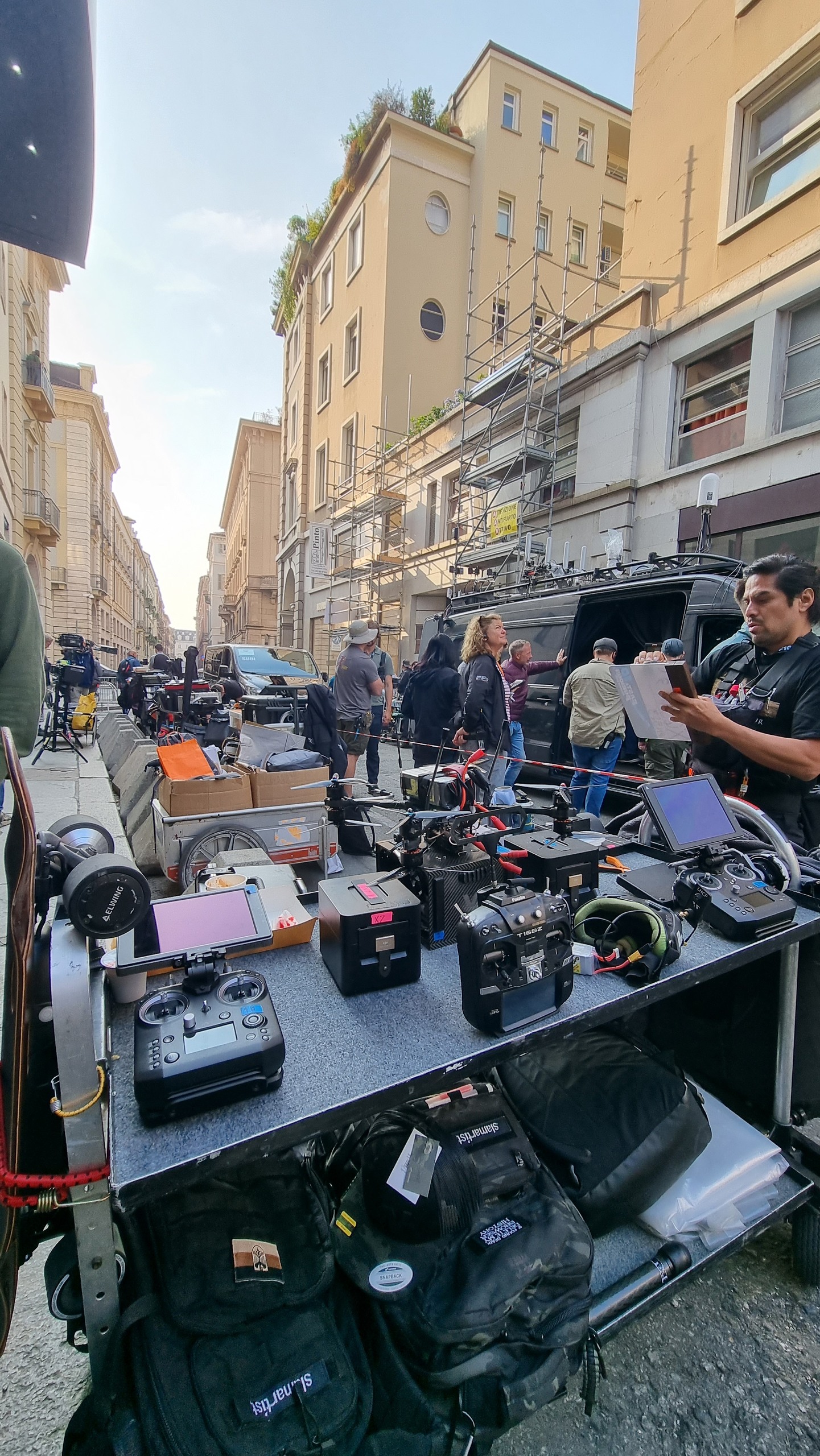
| Portable, redundant unit package | Keep the different configurations available across changing assignments and production units. | Interchangeable cameras and controls, redundant aircraft, prepared batteries and self-contained Pelicases support the crew’s mobility. | Deployment and autonomy, case photographs and the two separate readiness timings. |
Separate the carrier, the camera and the person making the image
A drone, an RC car, a pole and a motorcycle solve different problems of physical camera placement. Their use does not explain the composition by itself. The shot still needs a subject, a reveal, a direction of attention and a relationship to the movement around it. Ferdi’s responsibility connected those image decisions to the practical means of making them.
The RC assignment makes the distinction especially clear. The small vehicle seen by the audience belongs to the story. The second RC platform carries the camera that tells that story. For gimbal FPV, the aircraft’s route and the camera’s framing can be operated as distinct tasks. For the Sony assignment, Ferdi supplies the physical and visual operating expertise around a production camera. Recognising these relationships helps another production identify the service it actually needs.
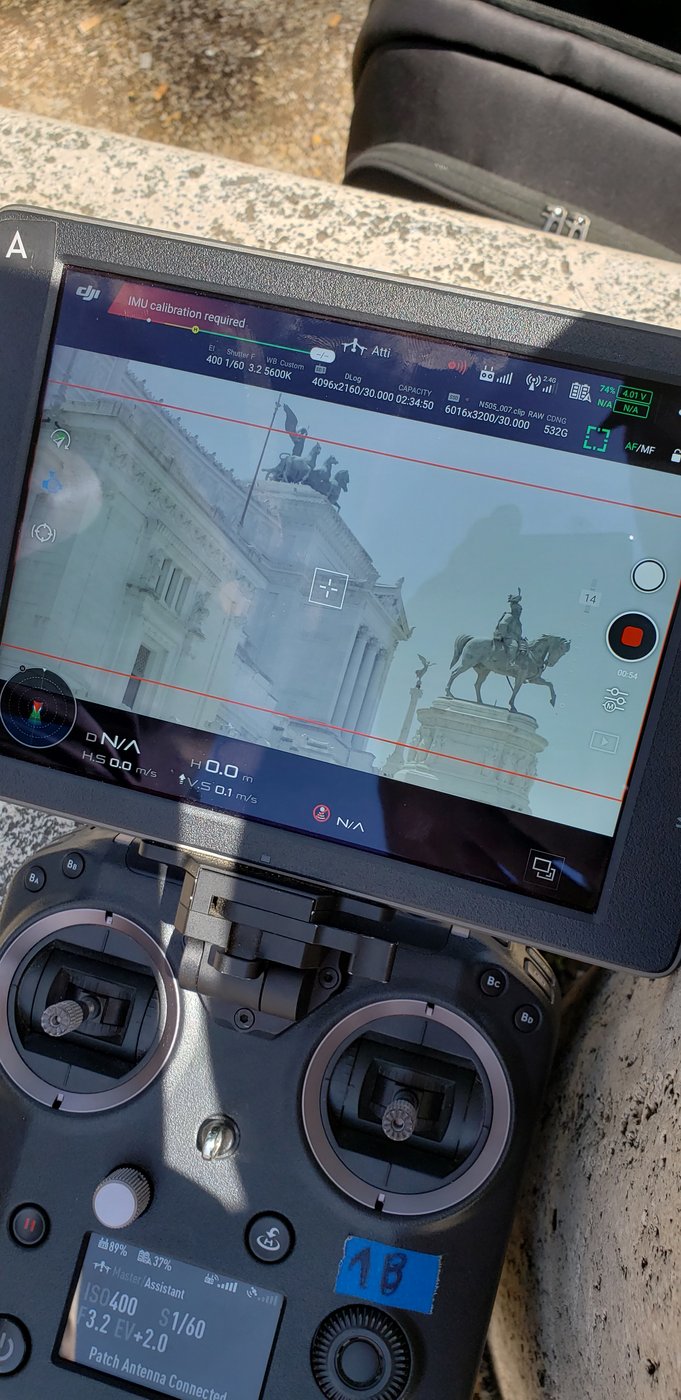
WarpSpeed® describes the gimbal-FPV approach further established through this work. The case’s technical details remain tied to the systems and configurations used on Fast X. Its central lesson is the relationship between the required image, the chosen platform and the people operating it.
Matching the production’s image
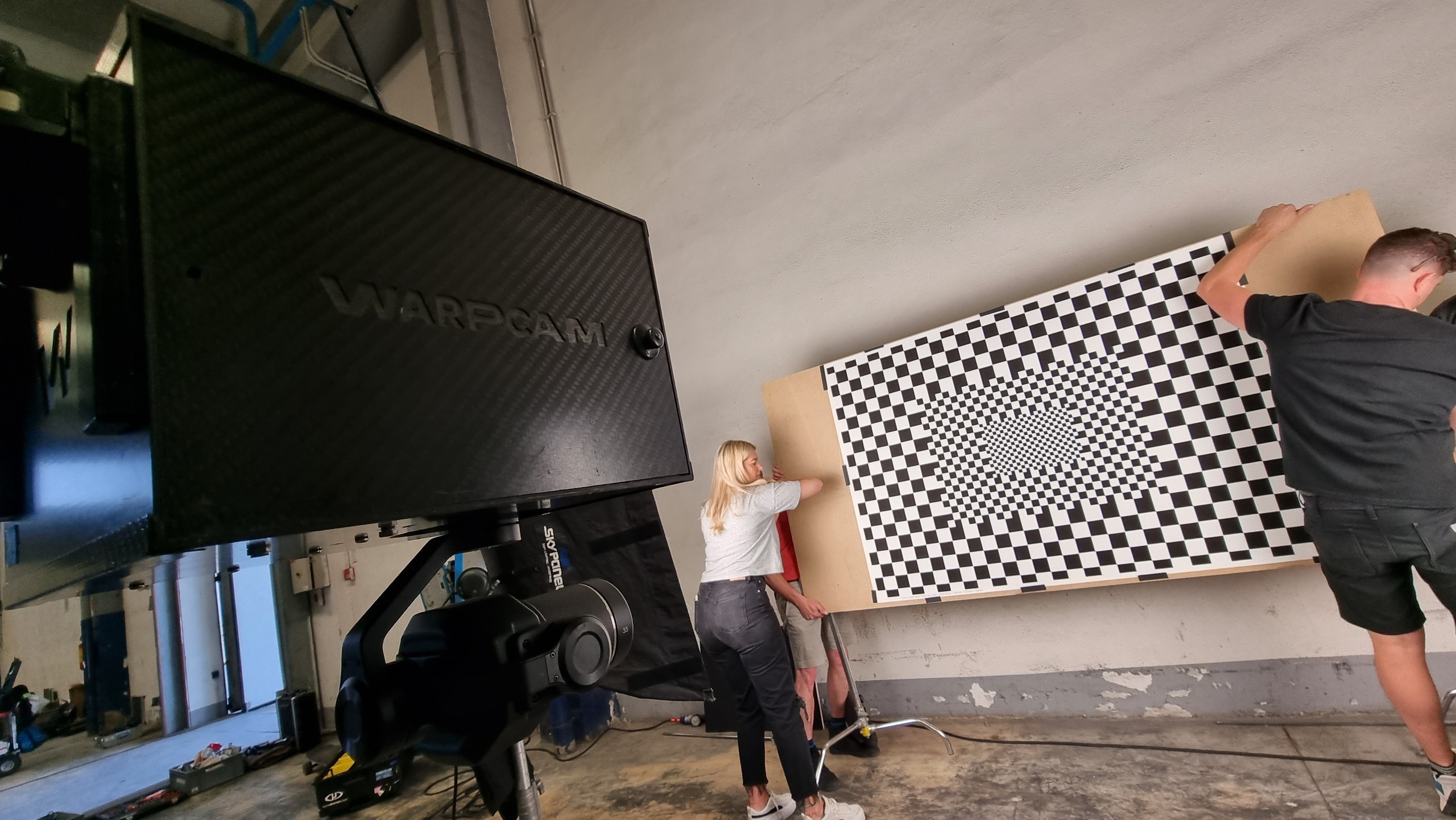
The WarpCam® work on Fast X used the system’s 6K generation, with a Super 35 sensor. Its small physical footprint gave the unit access to the camera positions described in this case; its image also had to belong beside the production’s principal cameras. Both requirements mattered to the DOP.
Sony VENICE was the reference for matching the live image on Fast X. Ferdi’s integration process connects the camera team with the DOP and DIT so the image reaching the monitors can be assessed in the production’s visual context. A matching LUT brings the live output or replay into that shared viewing pipeline.
Bring image requirements into preparation
Across productions, that preparation can include showing the DOP test material, agreeing resolution, sending camera tests to the DIT, measuring lenses with grids and working through colour variations. The combination depends on the production. Ferdi’s Fast X account identifies Sony VENICE live-image matching as a concrete application of that integration.
This gives a DOP a useful way to brief the unit: define the required shot and its physical camera position, then connect it to the show’s image requirements. The camera configuration, lens behaviour, viewing transform and intended post-production workflow belong in that conversation. The unit’s mobility and its integration with the image pipeline are parts of the same job.
Checking the images on an IMAX screen
Ferdi went to the IMAX in Leonberg to examine the finished film on a large screen. He sat in the front third of the auditorium so he could scrutinise the WarpCam® material among the Sony VENICE and ARRI ALEXA images. He could see no technical image-quality difference between the WarpCam® shots and the Sony VENICE and ARRI ALEXA material. He found that some WarpCam® images looked even better because they were better stabilised and framed.
The combination is central to the case: a camera compact enough for specialised physical positions, operated to create a deliberate composition, with images integrated into a major feature. WarpCam® subsequently developed into an 8K full-frame generation; the Fast X work described here belongs to the earlier 6K system.
One lead connected the creative and technical decisions
Ferdi’s position at the centre of the Floating Action Unit connected several decisions that a production otherwise has to coordinate separately. He could understand the action beat, develop a camera idea, determine whether an existing configuration could achieve it, organise the people needed and operate the camera himself when the assignment required him.
The approximately seven-person unit included camera assistants, camera operating, FPV pilots and focus support. Physical and virtual camera operating described complementary jobs within that crew. The physical operator moved the real camera through space; the virtual camera operator controlled its frame remotely. The focus puller maintained the required focus while those movements unfolded. The precise allocation could follow the shot.
Three views connect remote control, the drifting car and focus work.
Full source ↗How the work could continue in parallel
- Identify the image. Ferdi developed a shot or received a specific story or coverage requirement from the production.
- Connect image and method. He selected the camera position, configuration and operating roles around that requirement.
- Brief the working team. For FPV assignments, the flight and independently controlled frame were coordinated around the same action.
- Let the instructed crew execute. Once the shot was understood, the FPV team could continue its assignment.
- Contribute elsewhere. Ferdi could take on A-camera operating while the prepared team continued its work.
This parallel capacity was part of the production service. Ferdi’s personal availability at another camera position did not require the FPV work to lose its already established creative direction. The briefing, the trained roles and the prepared camera systems carried that direction into execution.
Creative freedom required a complete working unit
The director’s permission to move across the set and find the strongest additional shots gave Ferdi room to contribute. The unit’s preparation made that permission productive. Recognising an opportunity was one responsibility; having the camera, controls, batteries and crew ready to capture it was another. Fast X brought both into the same operating model.
The unit remained connected to the wider production through the director, DOP and the Second Unit assignments it principally supported. When a Third Unit or splinter assignment needed it, the crew could move with its working package. Ferdi’s leadership concerned that mobile team and the images it was tasked to deliver.
How to read the production footage
The complete split-screen film and the shorter comparisons let the reader connect an image to its making. The useful detail is often the relationship between the views: a low camera result above a photograph of the camera platform, or a motorcycle image beside footage of the camera operator travelling with it. A visible monitor or controller adds another part of that chain.
Watch the scene first, then watch the people and equipment creating the viewpoint. The short players preserve the source’s split-screen layout so those relationships remain visible. Some source images are production previews before final visual effects. The official trailers at the end provide the finished presentation of the film.
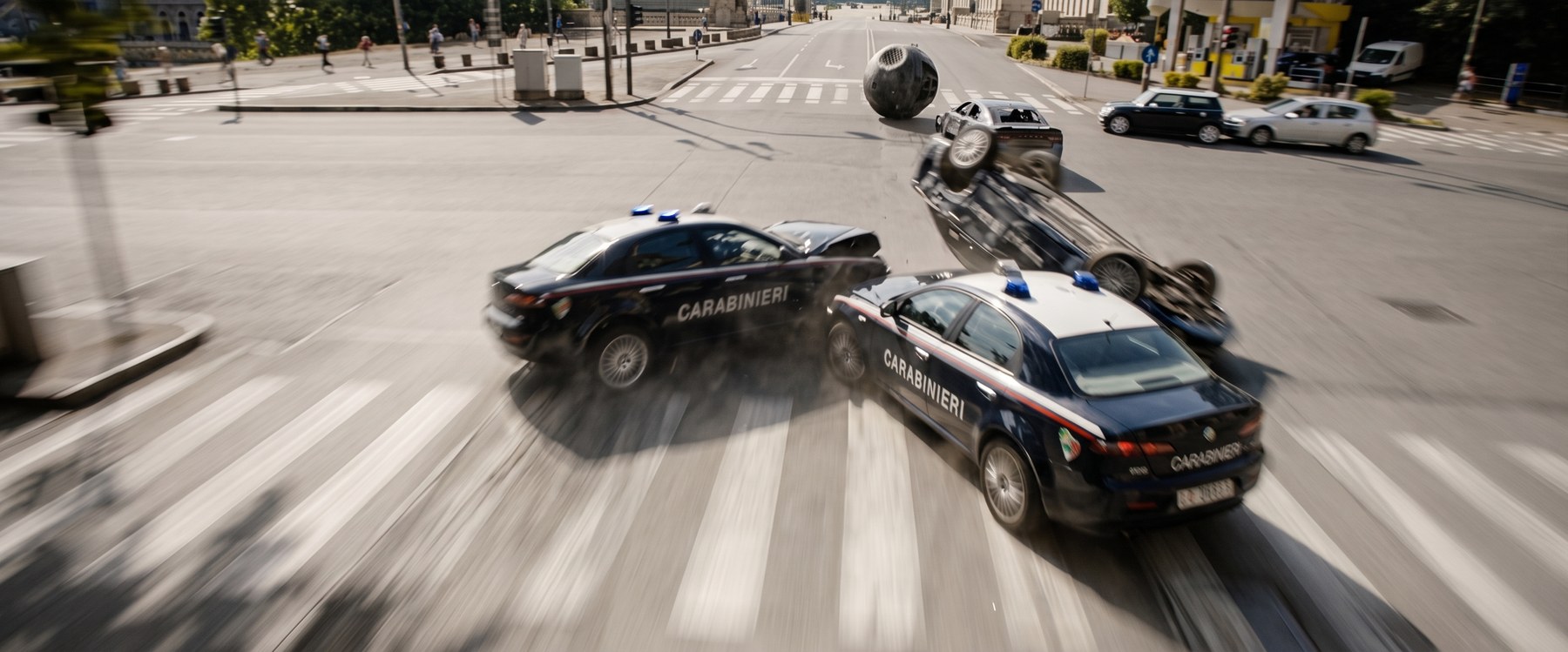
Understand the requirement
Read what the audience needed to see and why the sequence needed that viewpoint.
Inspect the physical solution
Look at the camera carrier, its position and the people operating it in the BTS view.
Connect control to image
Where present, compare the controller, focus work and monitor view with the resulting frame.
Watch the image in context
Return to the corresponding camera result, then view the official trailers after the case chapters.
| Example | What to look for | The decision it makes understandable |
|---|---|---|
| RC narrative coverage | The two separate small vehicles, the low camera platform, its monitor image and the resulting low viewpoint. | Develop a camera system around a story beat that needs to be understood at a different physical scale. |
| Gimbal FPV | The aircraft carrying the camera in the making-of image and the corresponding moving viewpoint. | Coordinate flight, framing and focus around the action’s narrative requirement. |
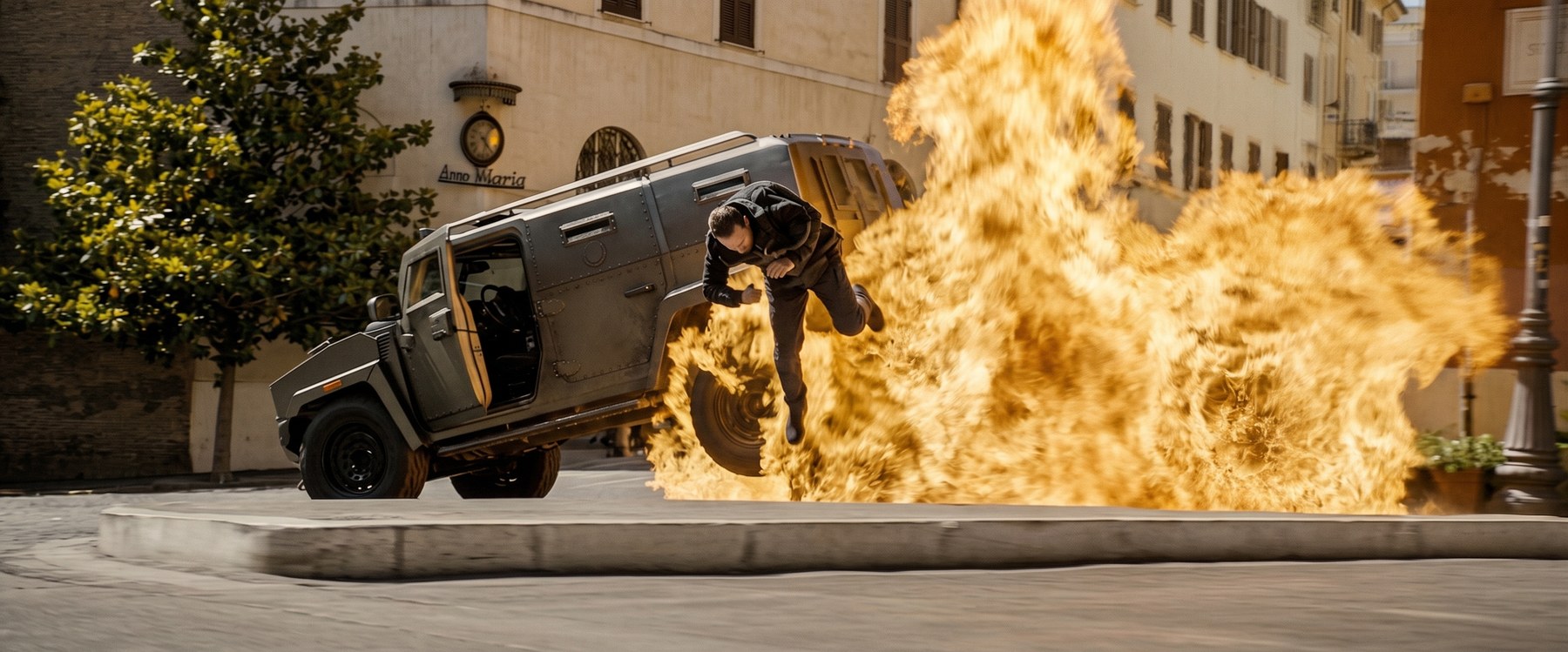
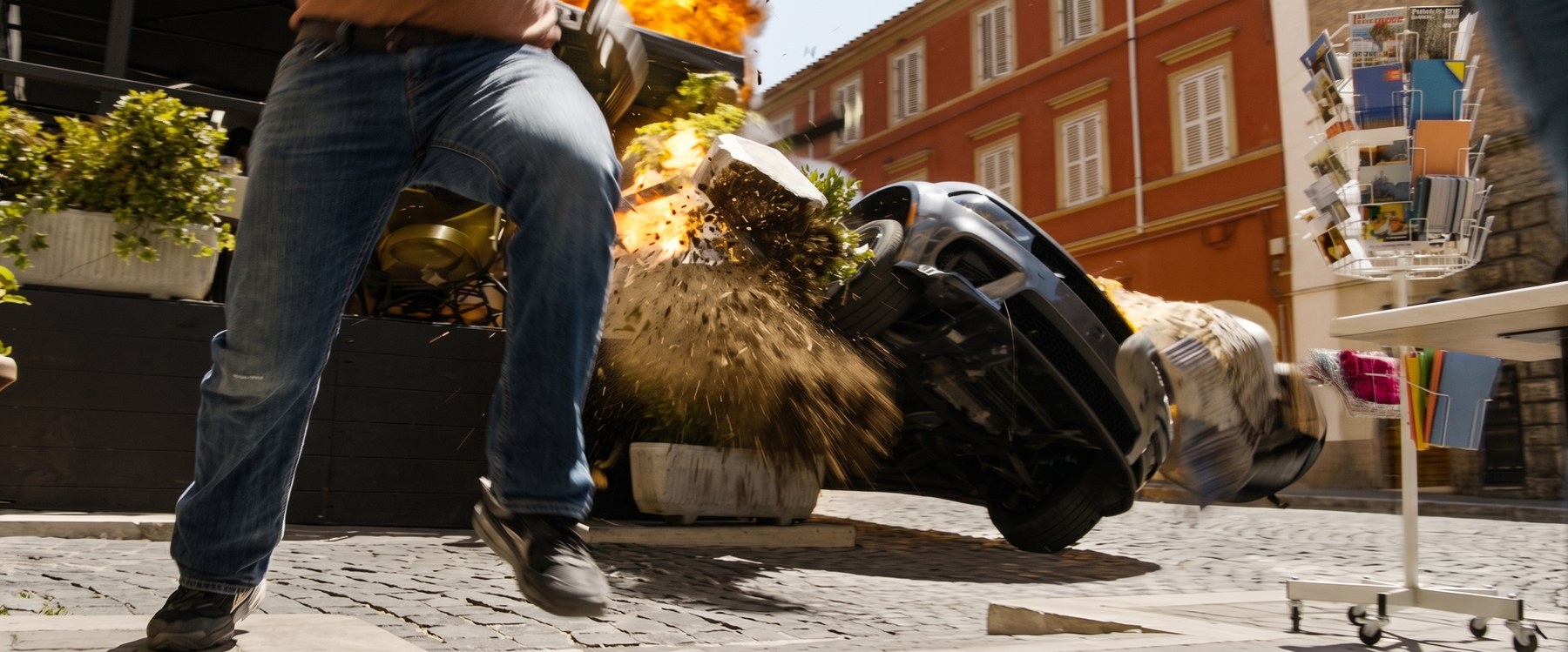
| The café composition | The person photographing in the foreground, the Lamborghini and the exploding Humvee in the multi-view source. | Design the whole frame so everyday foreground behaviour and large vehicle action contribute to one image. |
| Personal A-camera operating | The compact head held separately from the carried camera body in the original production photographs. | Combine the production camera with Ferdi’s physical-action knowledge and close-action operating experience. |
| Motorcycle and ground pole work | The camera passenger travelling beside a stunt motorcycle; the separate pole, controller and monitor views in the ground example. | Choose physical camera movement and operating roles for the required relationship to the action. |
| Staircase recovery | The leading motorcycle image and the wider view of the stair assignment. | Preserve the required shot by changing the camera solution after the preceding arrangements failed. |
Ferdi’s account supplies the creative decisions, responsibilities and production events behind these examples. The photographs and comparisons make the associated work visible. Together, they let a producer, director or DOP follow the decision from a practical problem into a photographed result.
The café image: designing the whole frame
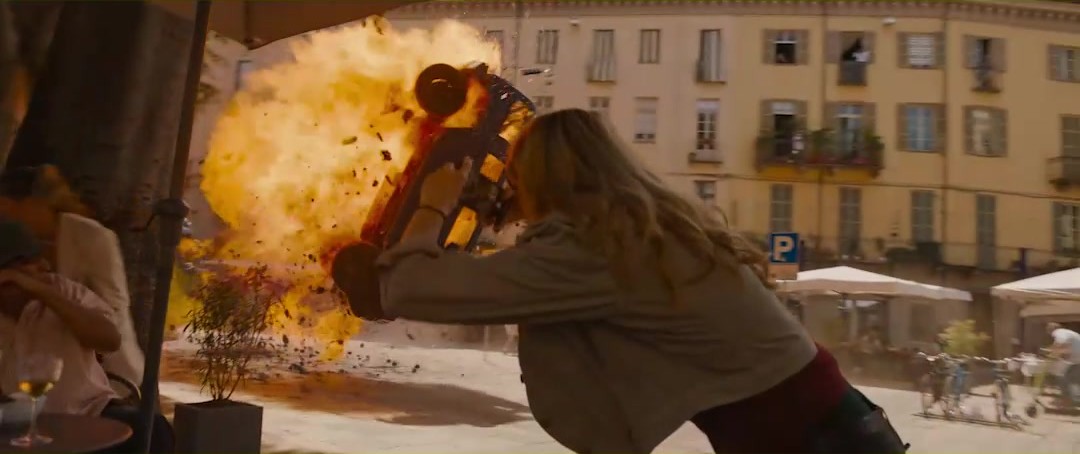
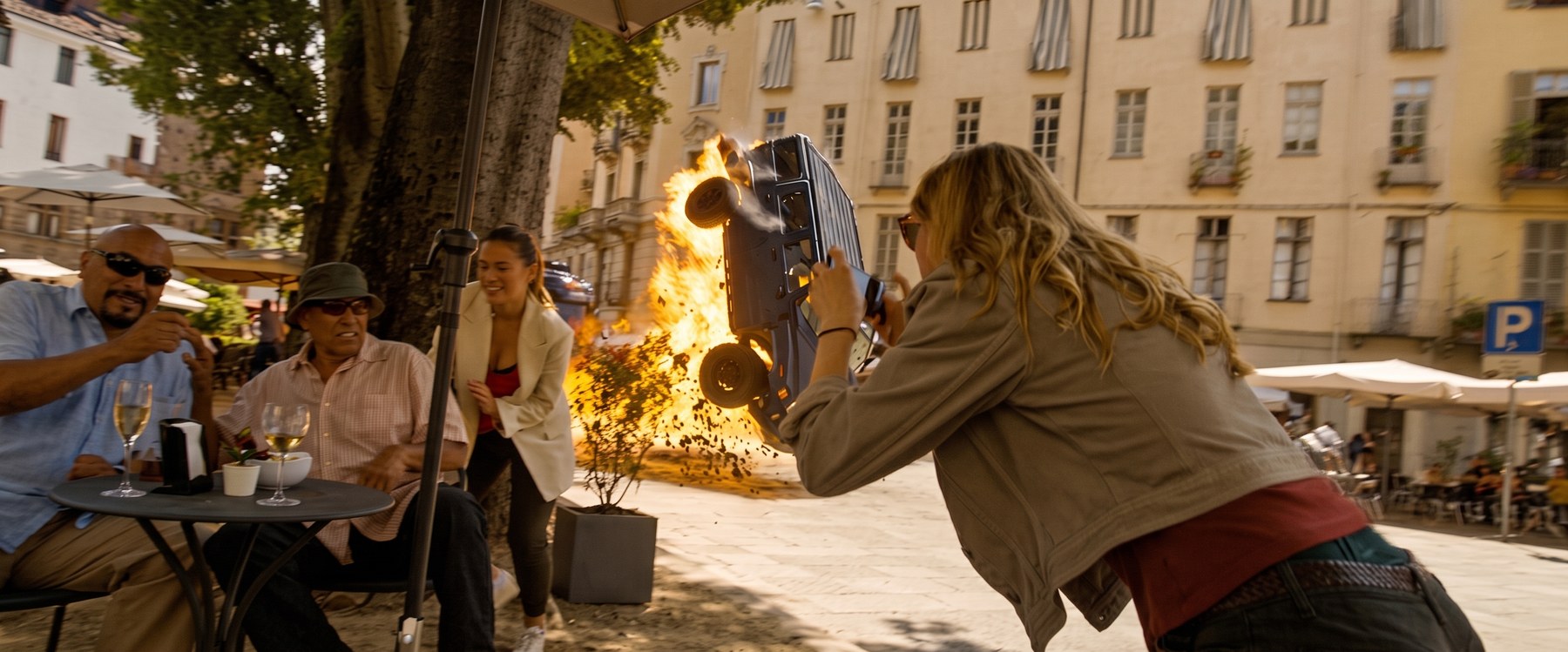
One of Ferdi’s images places an ordinary social moment in the foreground of an extraordinary event. A person photographs a group near a café. Behind them, a Lamborghini escapes as a Humvee explodes. The shot brings human behaviour and large-scale vehicle action into the same composition.
Ferdi conceived that arrangement. He developed the placement of the people, the camera movement and the slow-motion treatment as parts of one image. The foreground gives the eye an immediate point of interest; the action behind it changes what the audience understands about the space.
The director initially considered the idea too complex. The DOP supported it, and the shot was delivered. It appears in all of the Fast X trailers.
The third strip shows Ferdi’s composition: people being photographed in the foreground, with the Lamborghini and exploding Humvee behind them.
Full source ↗The value of this example is the completeness of the decision. Ferdi’s contribution encompassed what would happen within the frame, how the camera would reveal it and how the different layers would relate. The people, the moving car, the background event and the treatment of time all belonged to the same design.
Placed beside the RC sequence, the café shot shows two sides of the same practice. In one, Ferdi developed a physical camera system to make a story beat visible. In the other, he developed the image itself and brought its elements together for the camera.
What the foreground contributes
The foreground creates a familiar human activity before the background event changes the image. The viewer reads people arranging a photograph, recognises the car moving through the scene and then confronts the scale of the explosion behind them. That relationship gives the event a composed point of view.
In the four-view comparison, look at the third strip around the middle of the clip. It contains the café composition used for the opening still of this case study. The other views expose the broader production space and the physical event. The comparison connects Ferdi’s composition to the physical action and the wider production space.
A camera system developed because the story needed it
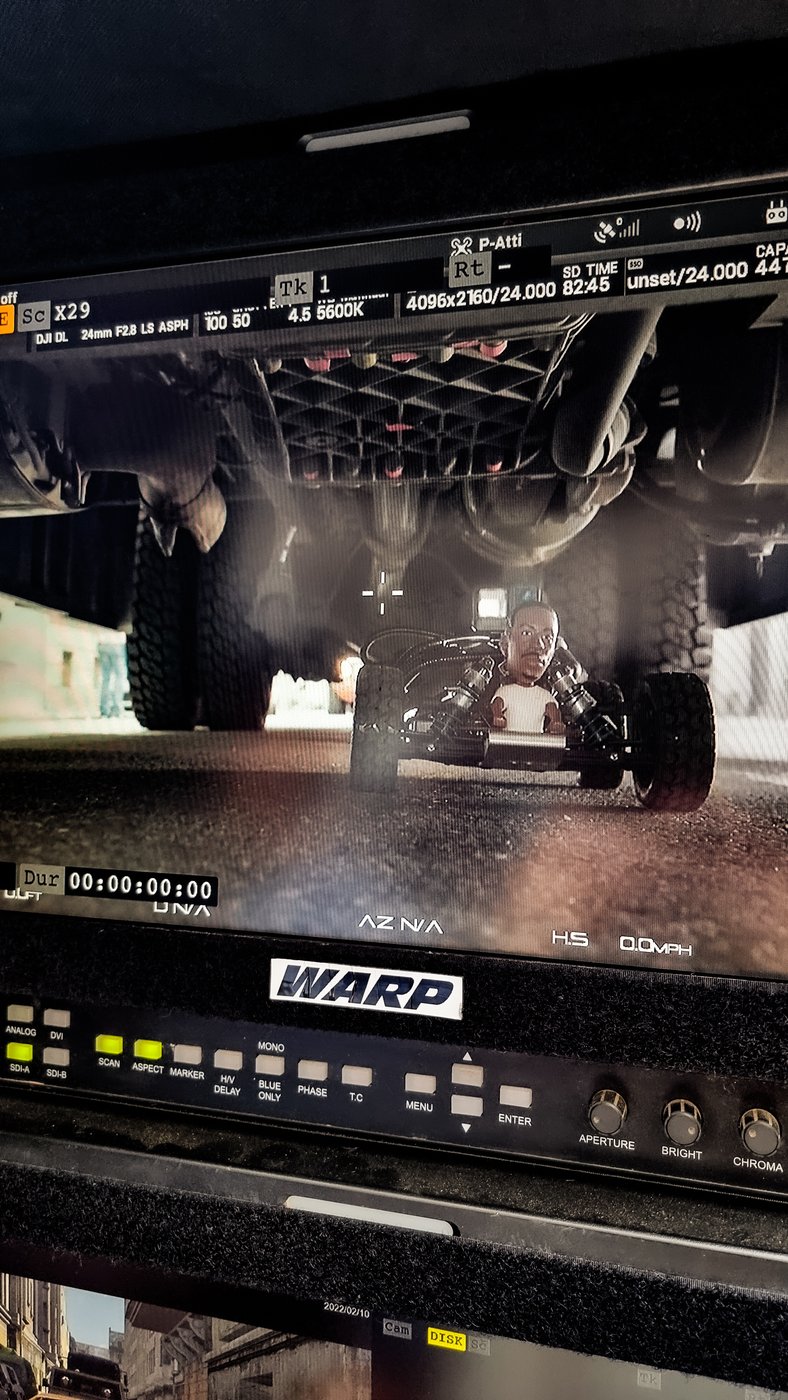
One of the clearest examples began with a small vehicle inside the story. An RC vehicle travels beneath a larger vehicle in the convoy and introduces sleeping gas. To follow that fictional action, the audience needed to understand what was happening close to the road and underneath the convoy.
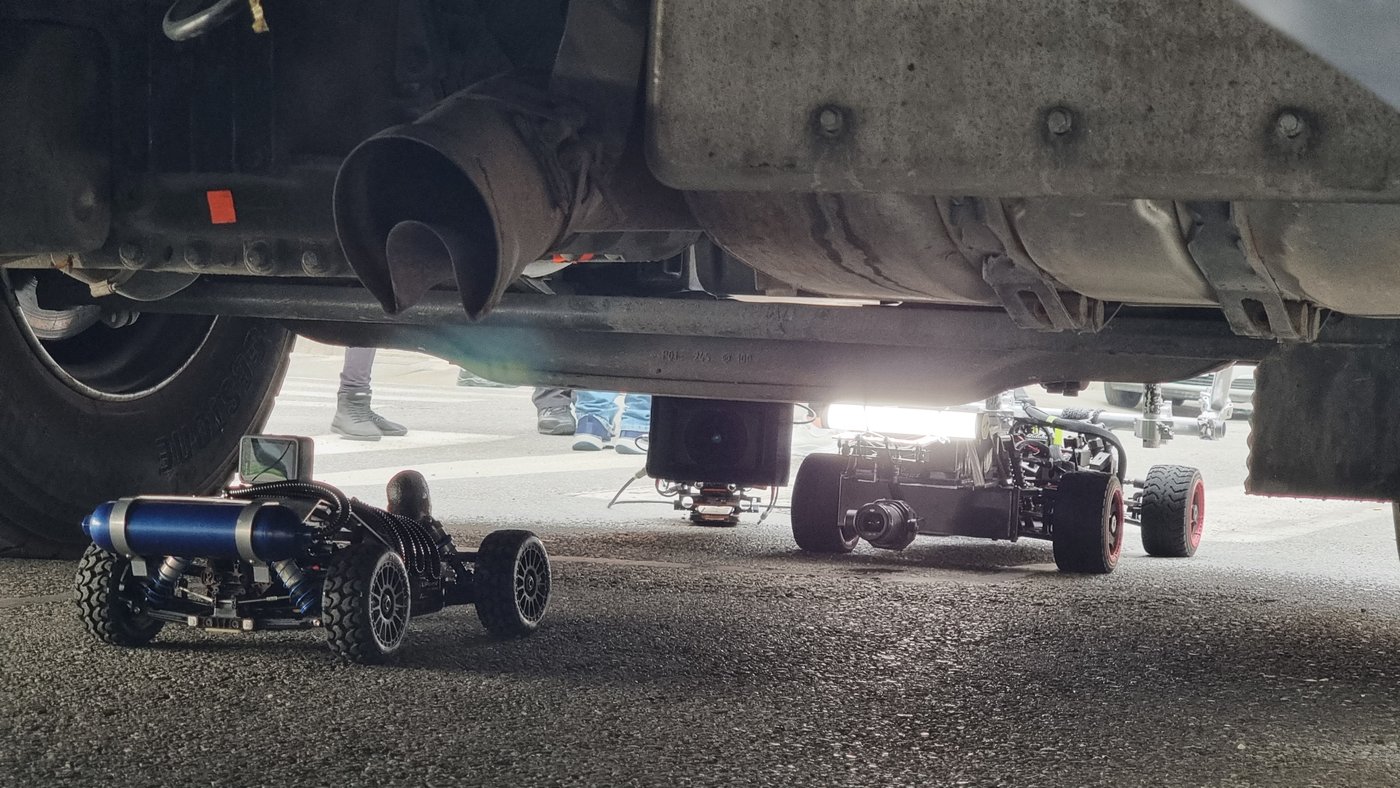
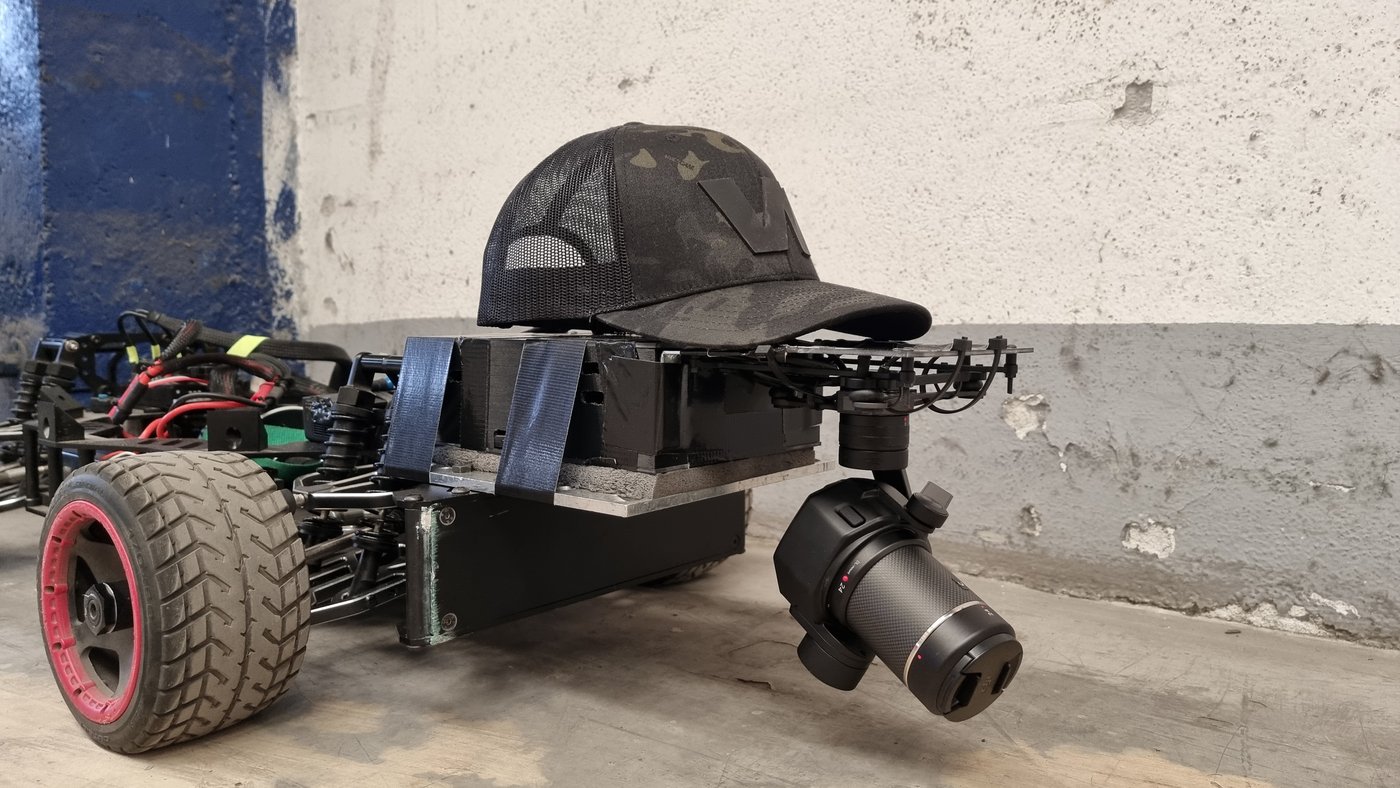
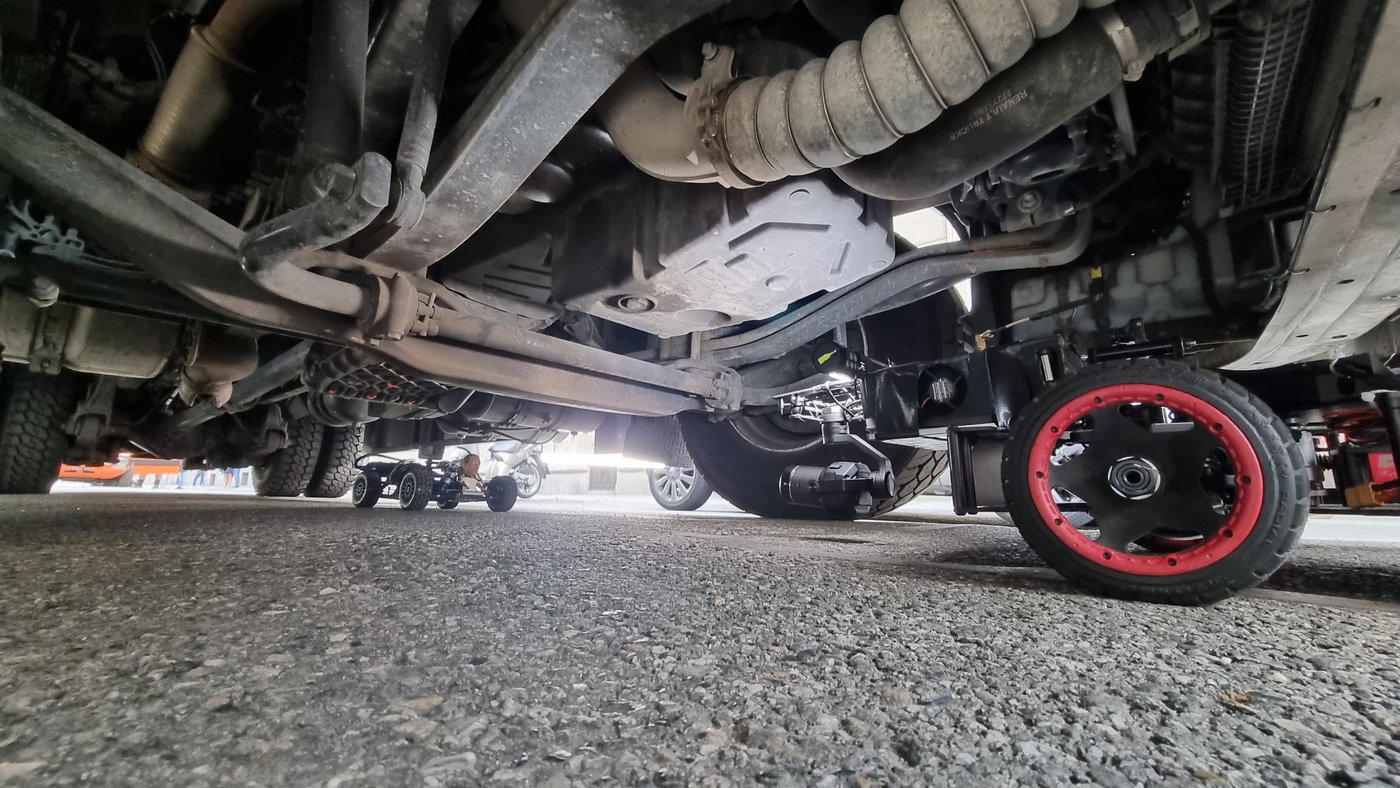
The DOP discussed that requirement with Ferdi before the shoot. The camera needed to share the level and movement of the story’s RC vehicle. Ferdi developed a specially adapted WarpCam® configuration on a low remote-controlled camera car to cover it.
This created a second moving vehicle with a different purpose: one RC car performed the story action, while the camera car photographed it. The system could follow, lead or travel alongside the picture vehicle, allowing the sequence to be covered from several directions while maintaining the low viewpoint.
A compact comparison of the low narrative viewpoint and the platform built to film it.
Full source ↗Ferdi’s team delivered the planned coverage and developed further movements around it. The camera position made a small but consequential action legible within a much larger chase. Its scale belonged to the object the audience needed to follow.
This is where the engineering and creative roles meet most clearly. A story requirement led to a camera requirement; Ferdi developed a system around it and then used that system to shape the coverage. The camera was developed around the story, and that development became part of the way the story was told.
Read the development in the comparison
The short RC film contains early tests, close views of the camera platform, work around the truck and the production monitor. Together, these views connect preparation to the low image the audience receives. The panels change roles during the edit: part of the upper panel shows the controller and monitor, bringing the operation itself into the comparison.
The original photographs make the two-vehicle relationship particularly clear. The picture RC car is the moving subject. The low WarpCam® chassis is the filming platform. The monitor photograph then shows the subject from the viewpoint created by that platform. This is a complete way to explain the development: story object, physical camera solution, operating image and photographed action.
Johnny FPV, WarpCam® and an independently controlled frame
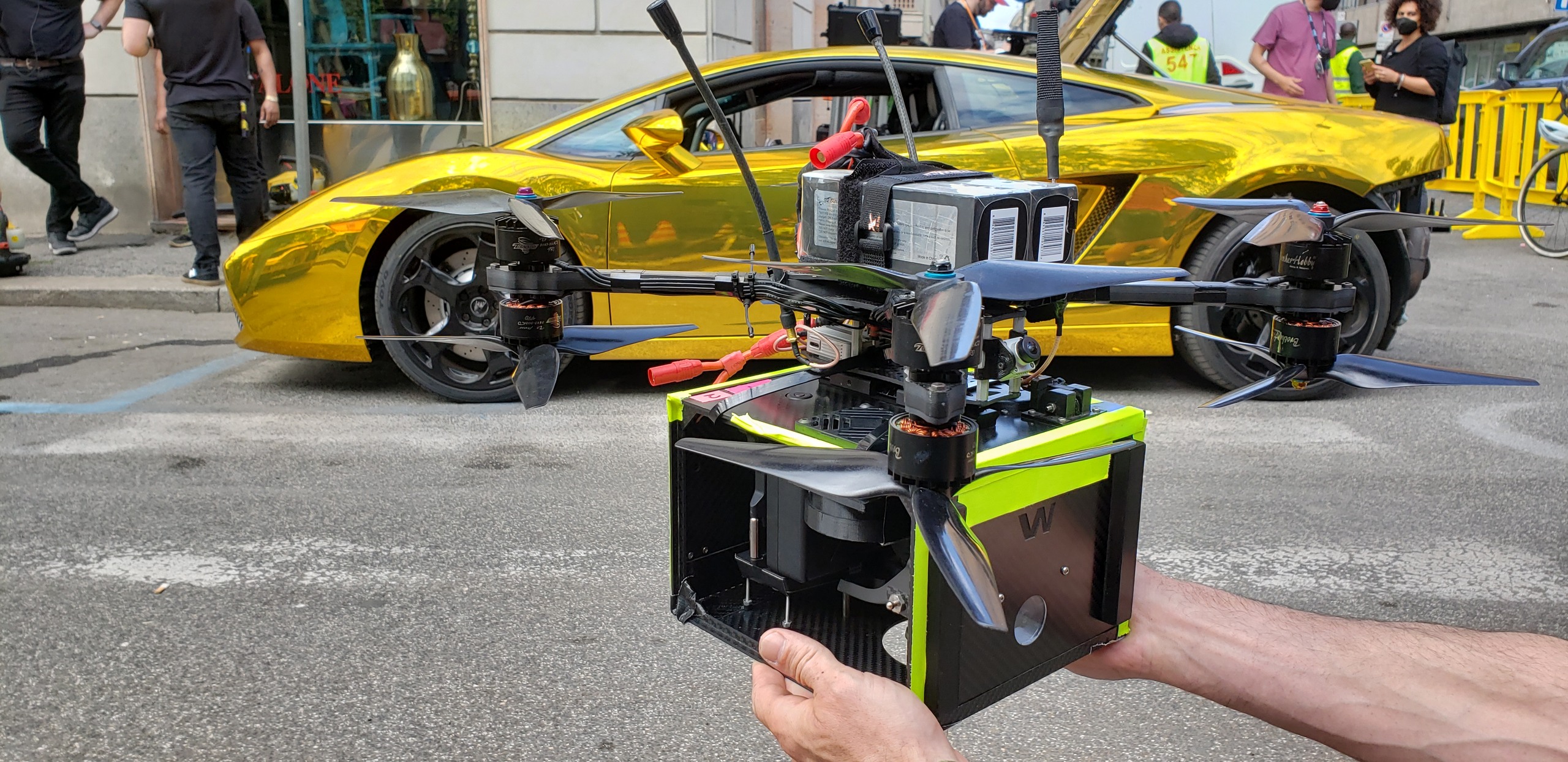
Johnny FPV worked within Ferdi Fischer’s Floating Action Unit. Their collaboration centred on flying WarpCam® as a gimbal-equipped narrative camera system. Preparation together in Los Angeles established the relationship between the flight and the independently controlled image.
The distinction matters on screen. The aircraft has a movement to execute, while the camera has a subject, composition and visual transition to maintain. Separating those responsibilities allows the camera to turn and frame through the flight rather than simply inherit every movement of the aircraft.
Ferdi coordinated the shots and the relationship between these roles. Johnny’s flying became part of a wider camera design involving the vehicles, the action and the image the sequence needed. This work helped establish the WarpSpeed® approach at major-production scale.
Follow the ball towards the parapet and water in the upper view. Around 2.9 seconds into this excerpt, the lower view reveals the aircraft carrying the camera beside the descending ball.
Source 00:58.88–01:04.42 ↗Once Ferdi had instructed the team and the shot was understood, they could continue their assignment while he moved to another camera position. That ability was an important part of the unit’s range. A functioning FPV team and Ferdi’s A-camera work could contribute in parallel.
Following the information through the movement
The bridge example gives that coordination a specific narrative task. The image travels with the ball towards the parapet, follows the transition over the edge and carries the movement down to the water. The viewer needs to retain a relationship to the object while the setting and direction of attention change.
The making-of view reveals the aircraft carrying its gimballed camera beside the falling ball. The camera view shows the resulting moving perspective. That pairing explains why a coordinated pilot and camera operator matter: movement through the scene and attention within the frame have to serve the same developing event.
The aircraft and the physical event in one view
The aerial images came from that collaboration: flight created the camera’s path through the scene, while independent framing gave that path its narrative purpose.
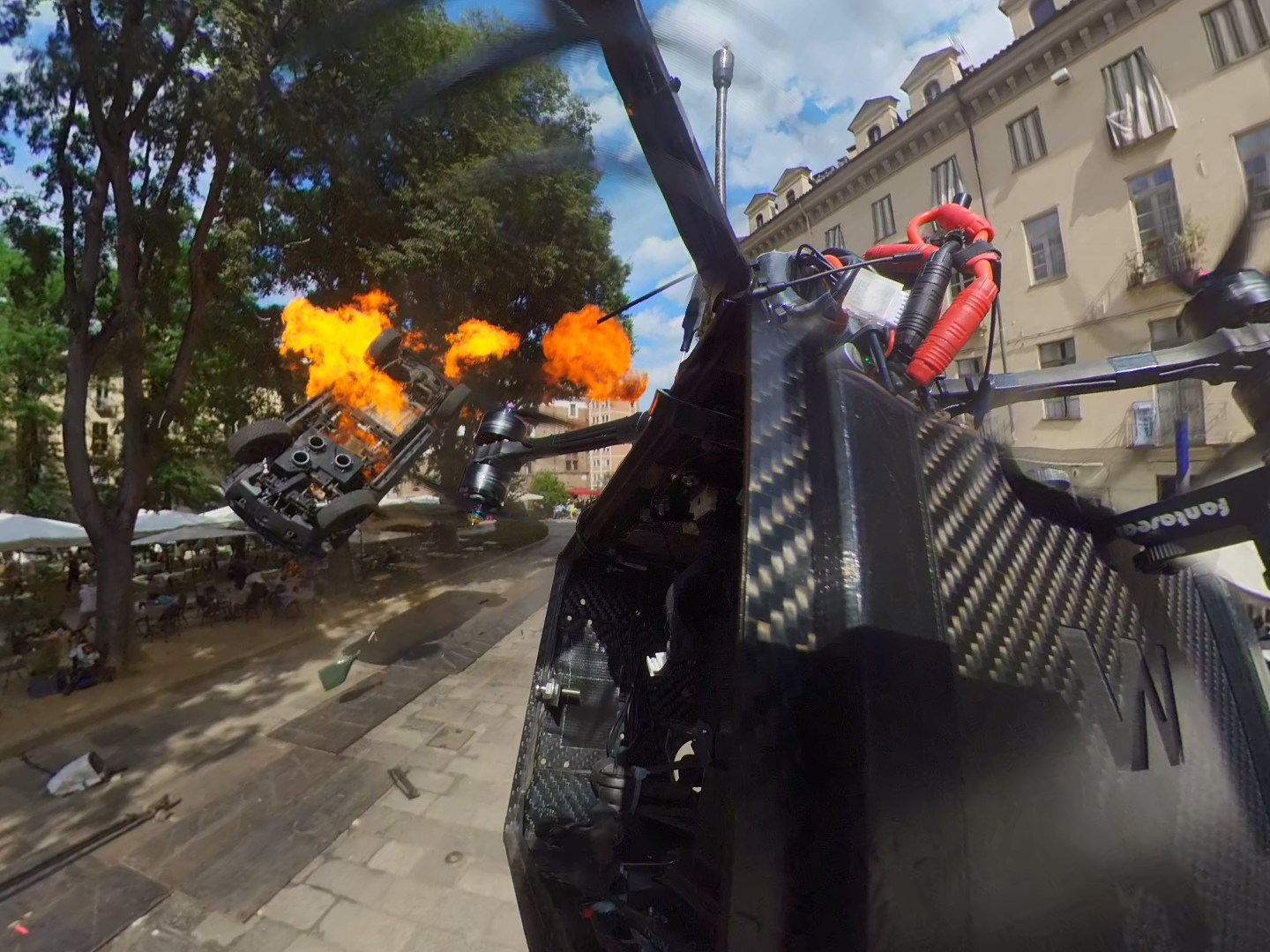
The onboard making-of view keeps the FPV airframe visible as the vehicle action develops.
Full source ↗Taking the production’s A-camera into the action
Ferdi’s assignments extended to the production’s Sony VENICE 2, including a detached-sensor configuration using the Extension System commonly known as Rialto. He repeatedly took on the close-action positions whose proximity and difficulty demanded his combined experience as a stunt performer and camera operator. These included shots that were too close to the action and too dangerous for other operators to undertake.
That experience informs more than the ability to stand near a stunt. It includes understanding the intended movement, reading its development and adjusting the image while remaining aware of the surrounding action. His camera decisions came from knowing the physical beat as well as the composition.
Ferdi’s spatial understanding of the camera meant knowing where the lens pointed and what it saw through the position and movement of his hands. He could frame the image without looking at a monitor, maintaining and adjusting the composition while keeping his attention on the physical action. His knowledge of the planned movement and his experience as a stunt performer informed that way of operating.
The wider team made those assignments possible. Ferdi could brief the FPV crew, leave them executing their shot and take the production camera elsewhere. His leadership and his personal operating work therefore contributed at the same time, through different parts of the production.
Personal operating with a visible trailer outcome
All of Ferdi’s A-camera shots appear in the Fast X trailers. This part of his contribution has a clear line from the operating position to the film’s public presentation: his physical-action knowledge informed the work at the camera, and the resulting images became trailer shots.
The original production photographs below show the compact lens and sensor-head assembly connected by cable to the separately carried camera body. They give a concrete view of the detached-head configuration discussed here. The operating account explains why Ferdi was called into those assignments and how they ran alongside the work of his unit.
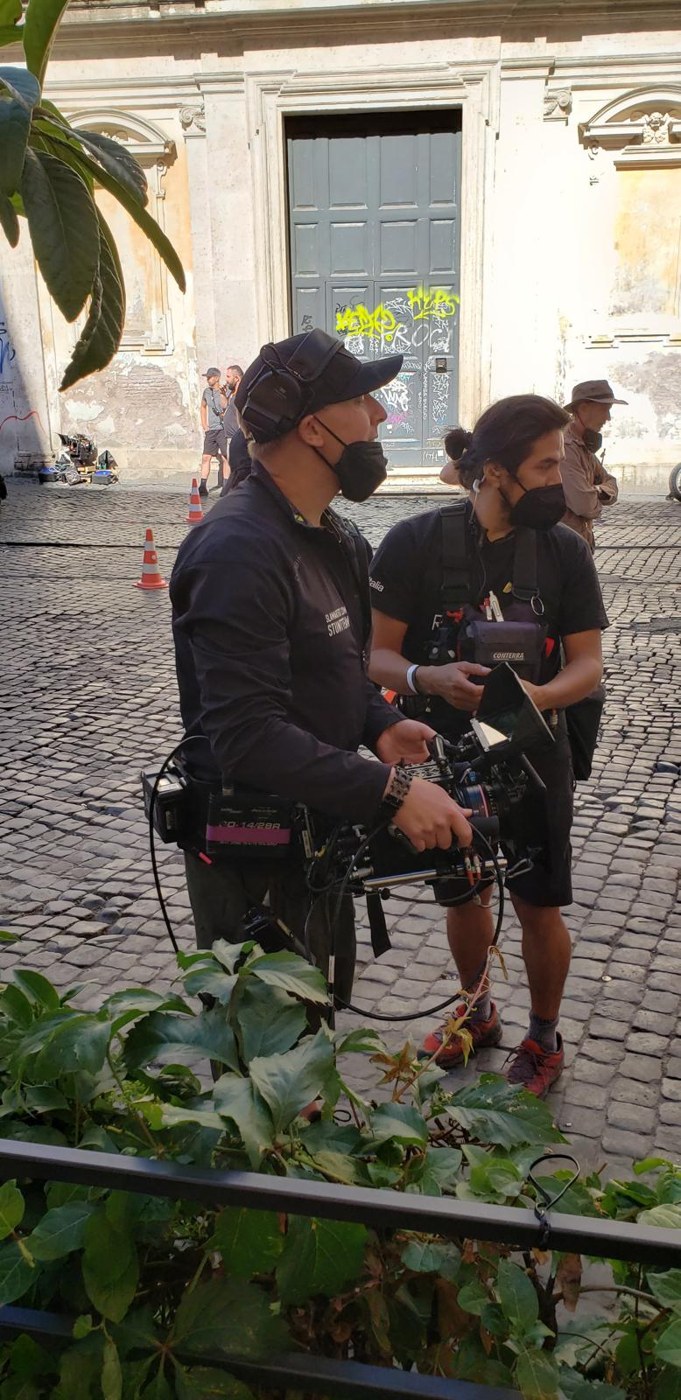
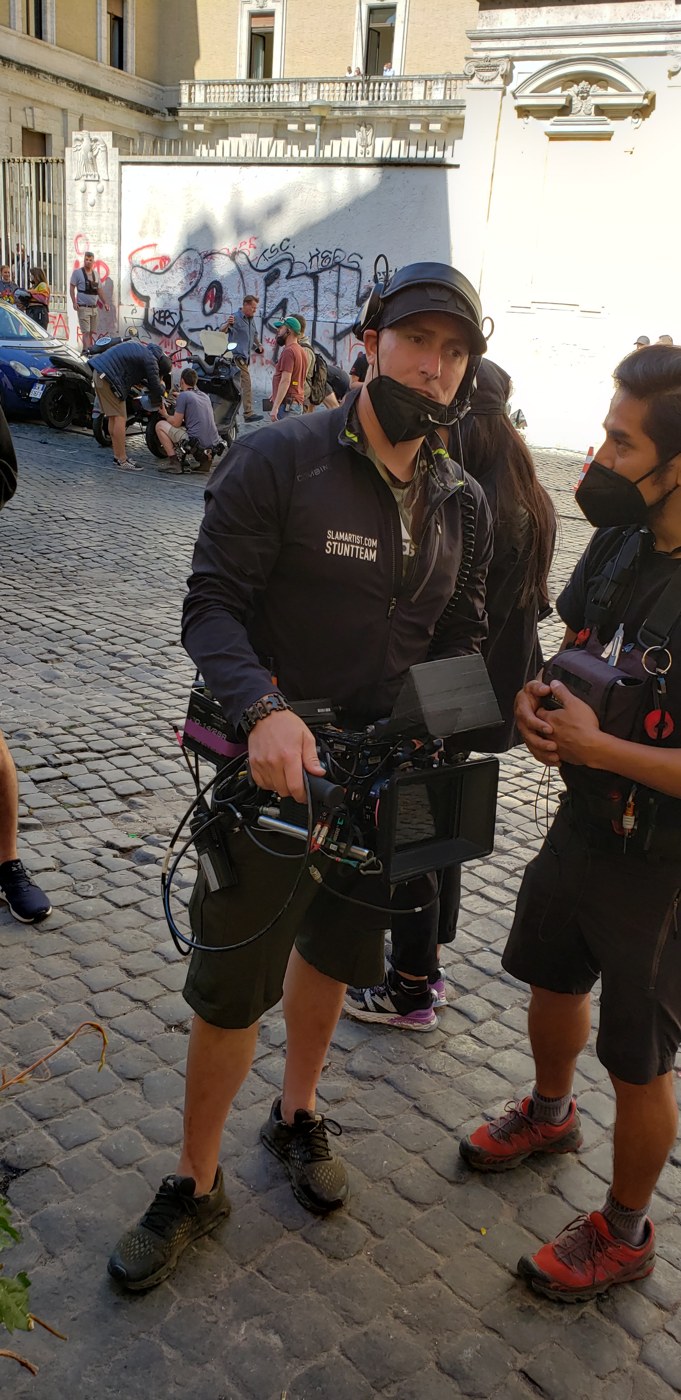
The existing edit opens with the two VENICE/Rialto operating photographs, then moves through café images, making-of comparisons and filmed monitor playback. Its original voice-over is preserved. Enable sound to hear it.
Full existing edit ↗Handheld, on the pole and on the motorcycle
WarpCam® handheld and pole work remained a constant part of the assignment. The unit used the camera across the set, adapting its position to the movement and the image. Other configurations placed it on vehicles, including fixed positions inside and outside them. The unit also used WarpCam® hard-mounted to a motorcycle and in fixed positions on tripods.
For motorcycle coverage, Ferdi also operated from the passenger position. Following and leading shots put the camera into the movement of the chase and gave him an immediate relationship with the riders being filmed.
The motorcycle example makes human-held operating particularly tangible: the making-of view shows the camera passenger travelling alongside the picture motorcycle with the camera carried low beside it. The camera image lets the viewer see what that position contributes to the chase.
The lower view reveals the camera passenger travelling beside the picture motorcycle. The upper view shows the low moving camera image.
Source 00:21.21–00:23.13 ↗These were different physical jobs within a shared camera method. A fixed vehicle position, a hand-carried move and a camera extended on a pole each create a different relationship to the subject. Ferdi could select that relationship as part of the shot, then work with the unit to execute it.
Physical movement and remote framing in the same shot
The ground-pole staircase example shows a motorcycle approaching and passing foreground bystanders. Its making-of comparison moves between the controller and monitor, the physical operator and the pole-mounted camera beside the motorcycle. The viewer can follow several responsibilities behind one screen image.
The physical operator gives the camera its route and position. The virtual camera operator controls the frame remotely. Focus work maintains the required subject sharpness. These are coordinated jobs within the unit, and their relationship changes with the shot. The separate three-view drift example in the operating-model chapter makes the control and focus layers visible while the picture car changes angle and distance.
The lower views connect remote controls and monitor, the physical operator and the pole-mounted camera. The upper view carries the motorcycle through the composition.
Source 00:32.21–00:35.96 ↗Vehicle attachments and human-held movement
Hard-mounted WarpCam® positions inside and outside vehicles were another part of Ferdi’s assignment. A vehicle-attached position creates an image relationship tied to that moving vehicle. Handheld and pole work allow the physical operator to shape the camera’s position through the movement. The unit could select among those relationships for the sequence’s different images.
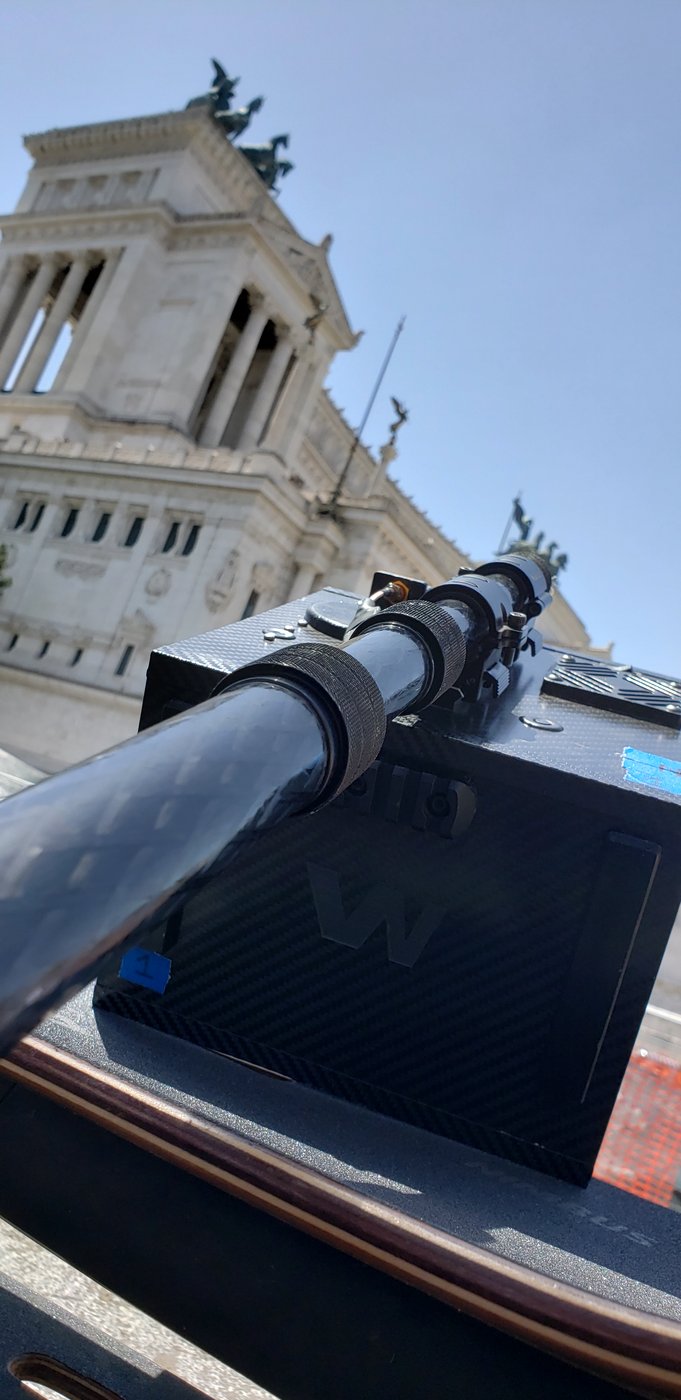
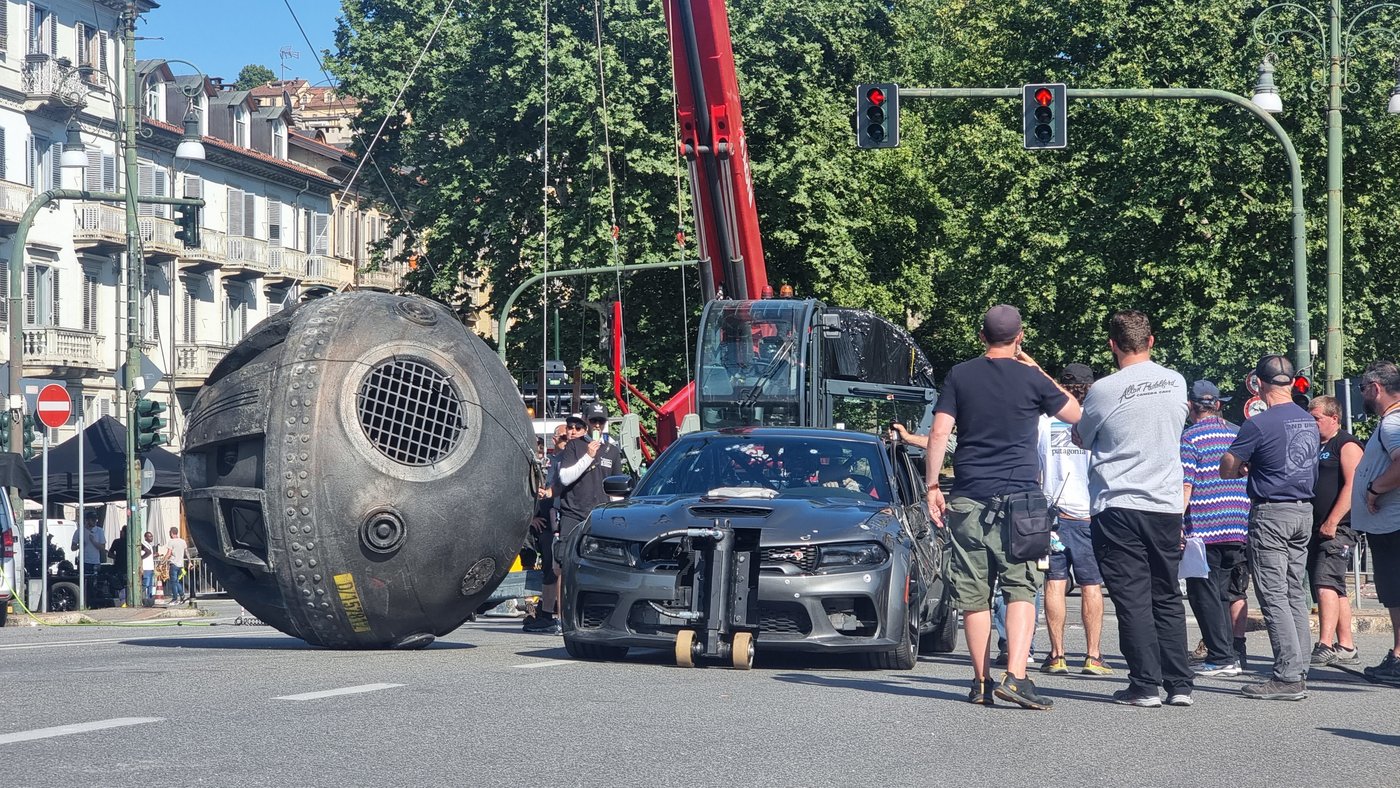
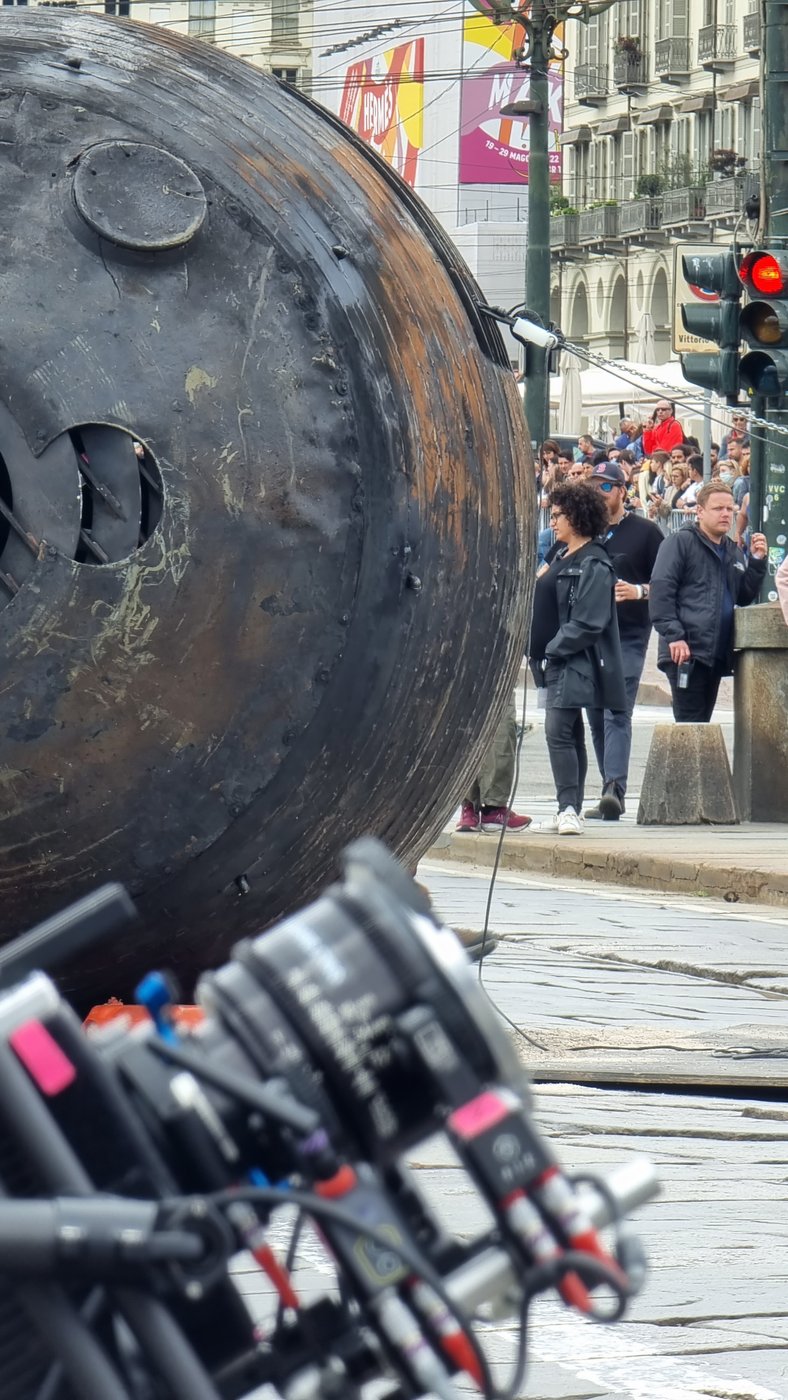
In each configuration, the physical placement changed what the audience could experience: the momentum of travelling with a motorcycle, the proximity of a low vehicle view or a camera movement extending beyond the operator’s body. The system gave Ferdi several ways to construct that relationship within the same production day.
An additional impact image from the Fast X archive.
Full source ↗See the camera position beside the performers
The making-of still places the pole operator beside two fleeing performers as the ball enters their street. The screen image concentrates the same sequence into a low composition: running figures in the foreground, the ball and its path behind them. Together, the views connect a physical operating position with what the audience sees.
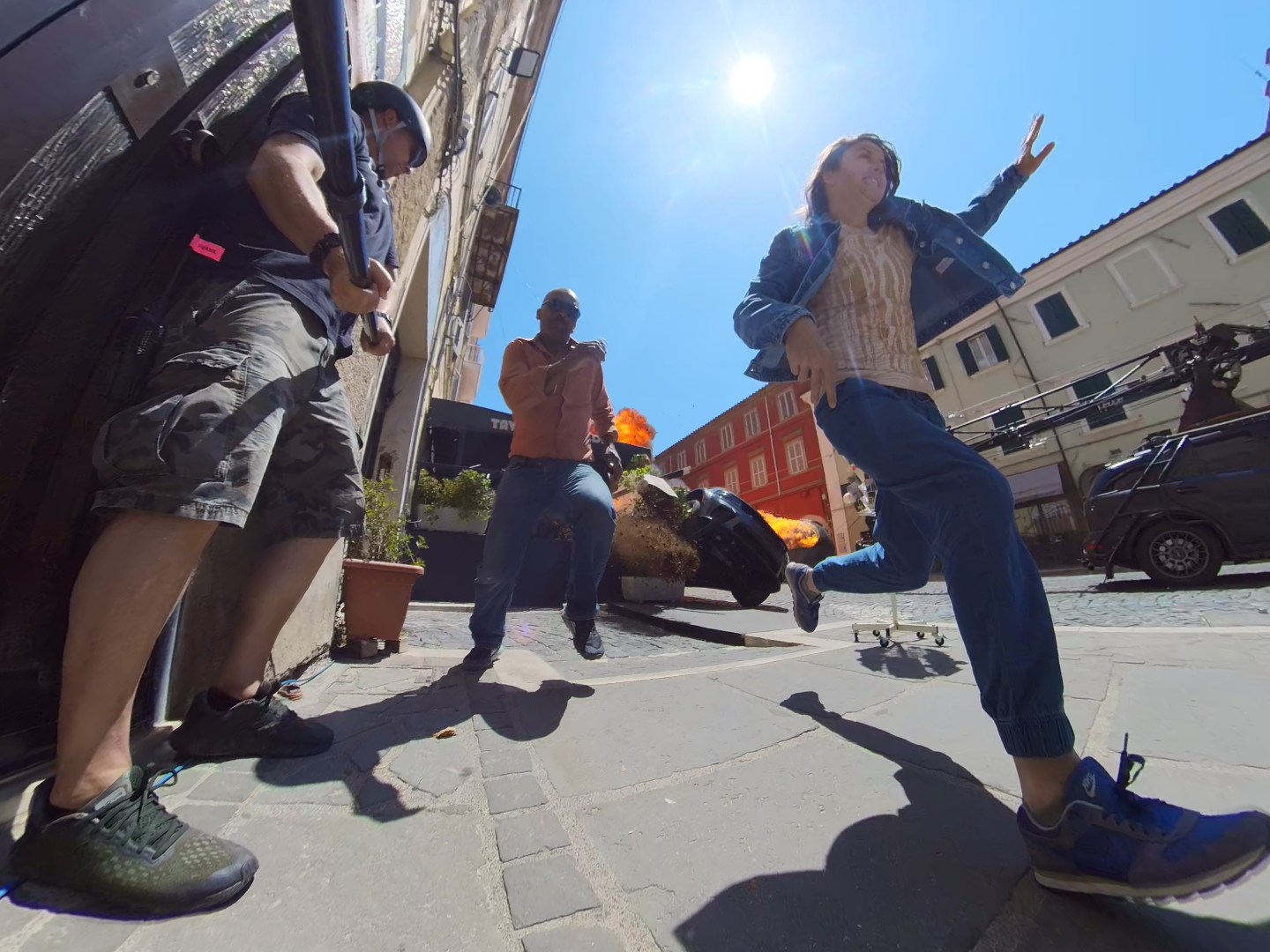
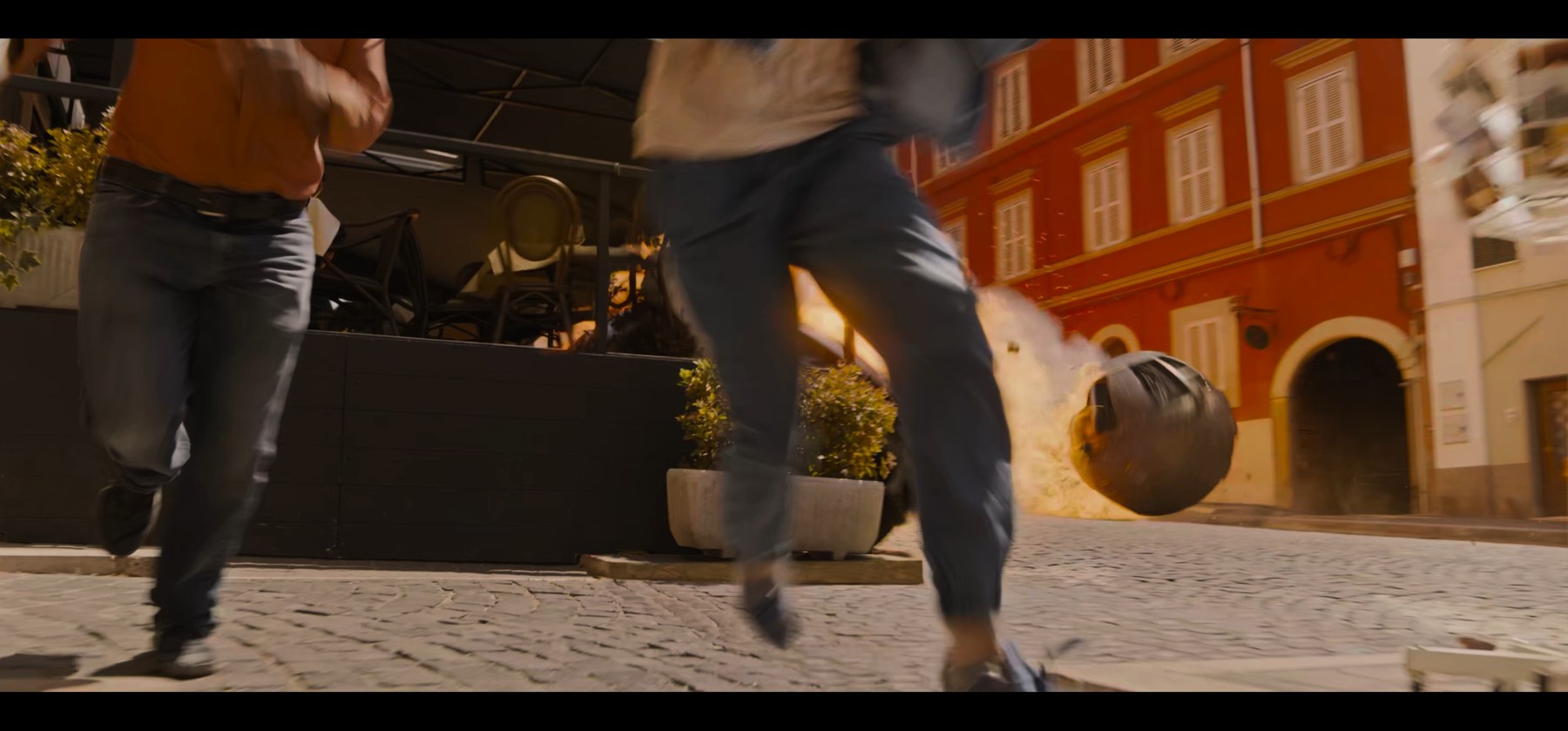
The original moving making-of view shows the operator, the two performers and the ball event behind the paired stills.
Full source ↗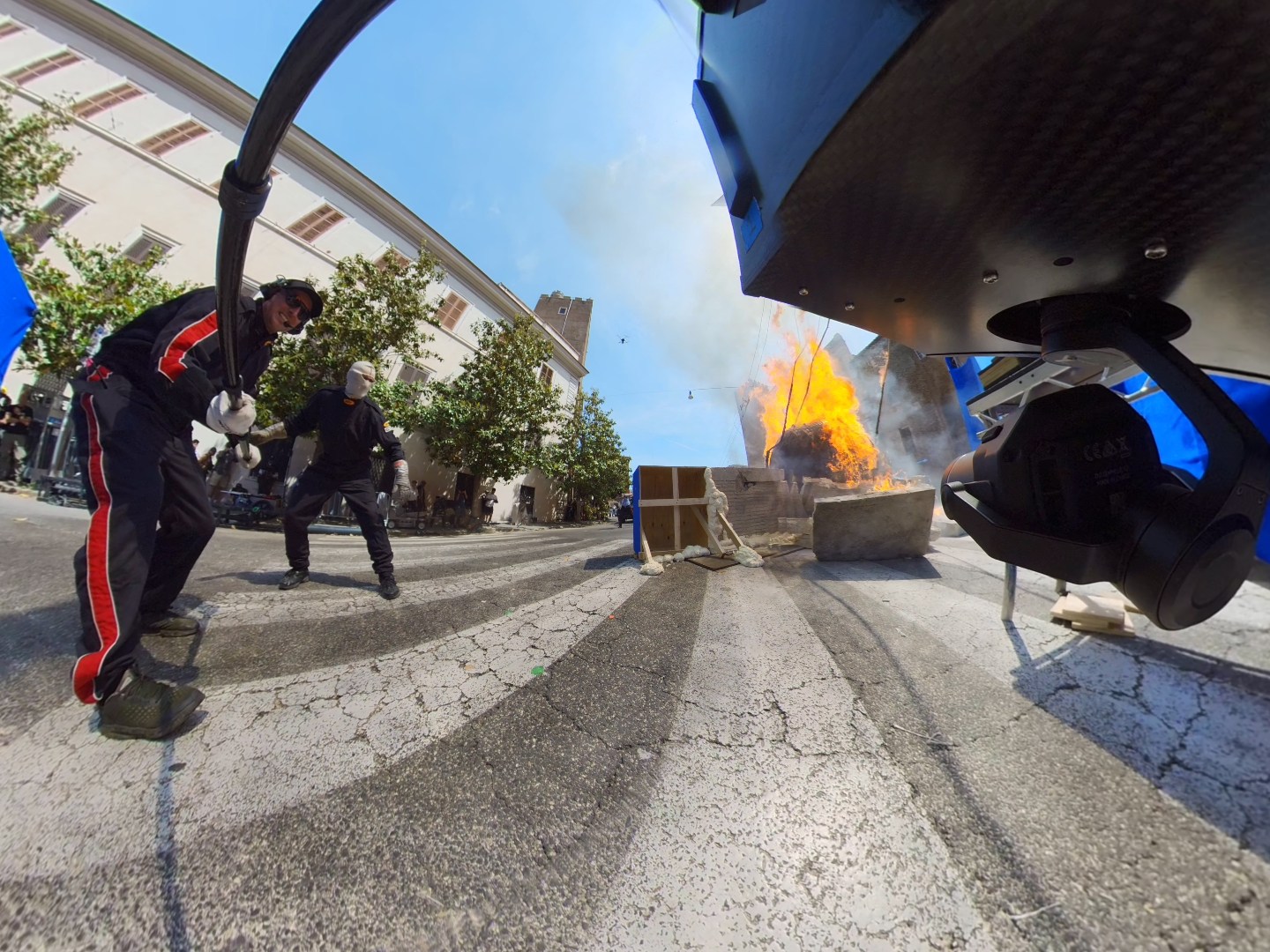
The staircase shot that the Floating Action Unit delivered
A fast motorcycle sequence on stairs required a leading camera view. The original arrangement placed a large camera head and Sony VENICE on an arm extending behind a RZR. On the first attempt, the arm failed and the arrangement produced no usable shot.
The production then changed to a motorcycle carrying an arm behind it. That solution also failed under the demands of the movement. The camera head, gimbal, lens and camera broke away and fell down the stairs, destroying the package.
The shot still had to be made. The Floating Action Unit supplied a different way to reach it: a pole-mounted WarpCam®, operated from the passenger position of the RZR and held outside the vehicle to generate the required leading shot.
Close leading images above; the wider staircase assignment, motorcycles and support vehicle below.
Source 00:52.79–00:57.33 ↗It was a decisive demonstration of the unit’s practical value. Ferdi understood the image the production was trying to obtain and could change the physical means of obtaining it. The crew had a camera system and an operating method ready to make that change.
The resulting shot rescued the assignment and the shooting day. A small, adaptable camera system and the crew’s physical operating experience delivered the image when the previous arrangements could no longer do so.
The production decision was to preserve the image
The desired leading shot remained the creative requirement through all three arrangements. The change was how the camera reached that position. Ferdi and the unit could work from the image backwards to another available operating method, drawing on compact equipment and physical camera experience already present at the production.
The unit kept the outstanding shot achievable by pairing another camera configuration with a crew ready to operate it. That adaptability delivered the required staircase coverage after two earlier arrangements had failed.
The support vehicle and picture motorcycles move up the stairs. The wider source gives more of the physical setting; the vehicle panel obscures the precise operating grip.
Full archived BTS source ↗Giving the sequence its place
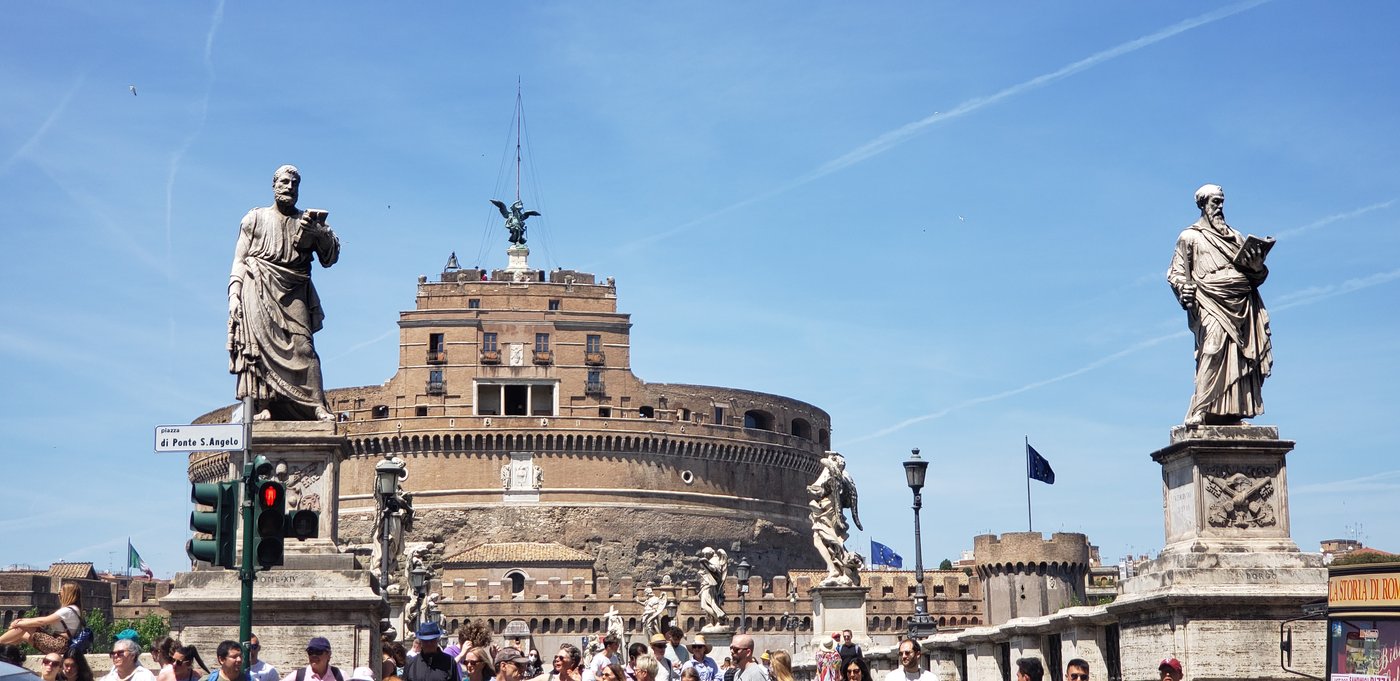
The unit’s work also included the opening imagery for the Rome sequence, including the view over the Roman fortress. These images established the city and the space in which the action would unfold.
Seen alongside the convoy and motorcycle material, they reveal the range of the assignment. WarpCam® could establish geography at one moment and enter a small, story-critical space at the next. Ferdi moved between these requirements with the same understanding that the camera position had to communicate something specific.
The city views give the chase its setting. The RC coverage explains a plot action. The close camera positions give the physical movement its immediacy. Together, they show a unit contributing across the sequence’s different visual needs.
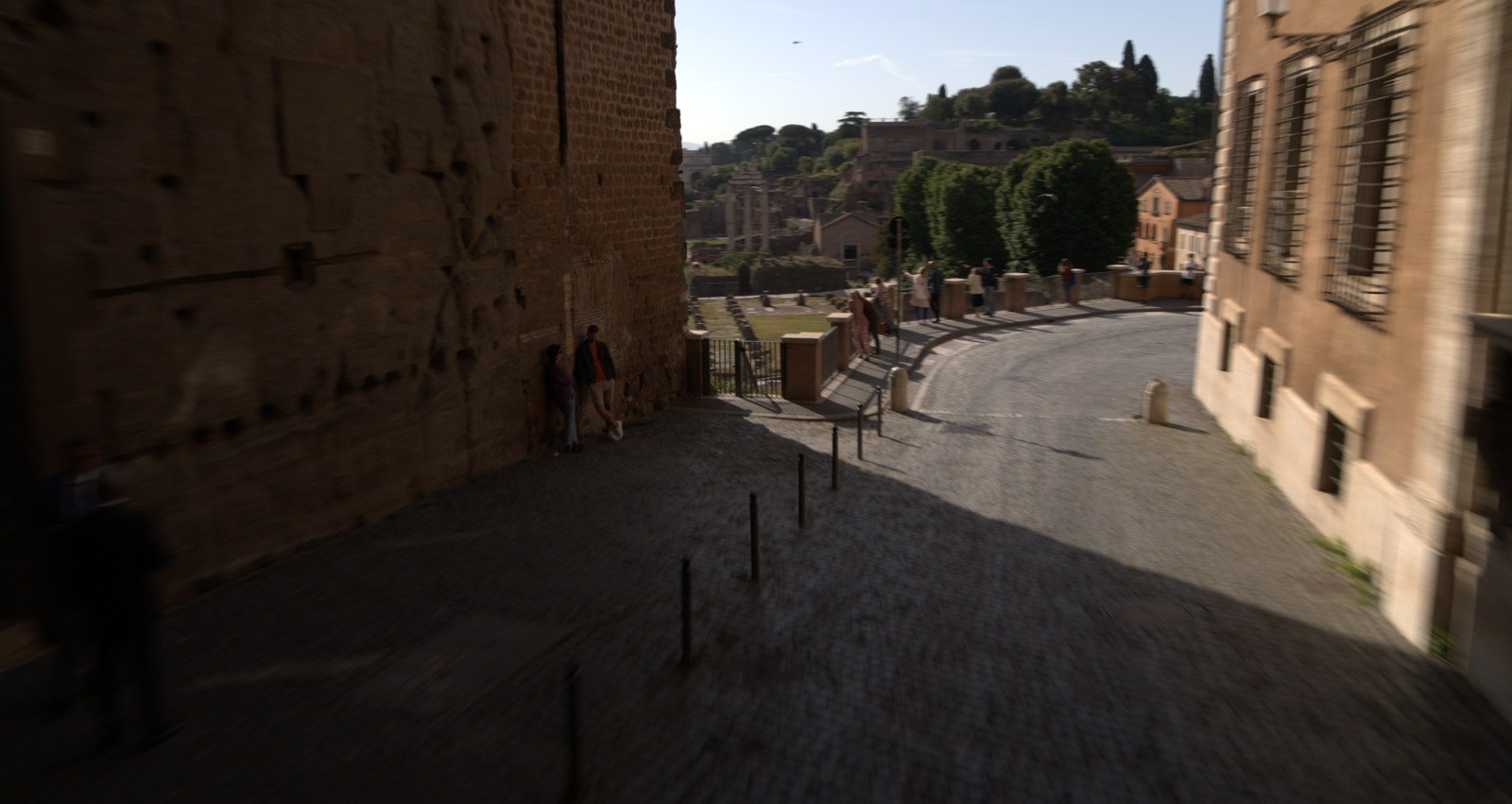
From a narrow passage to the city beyond
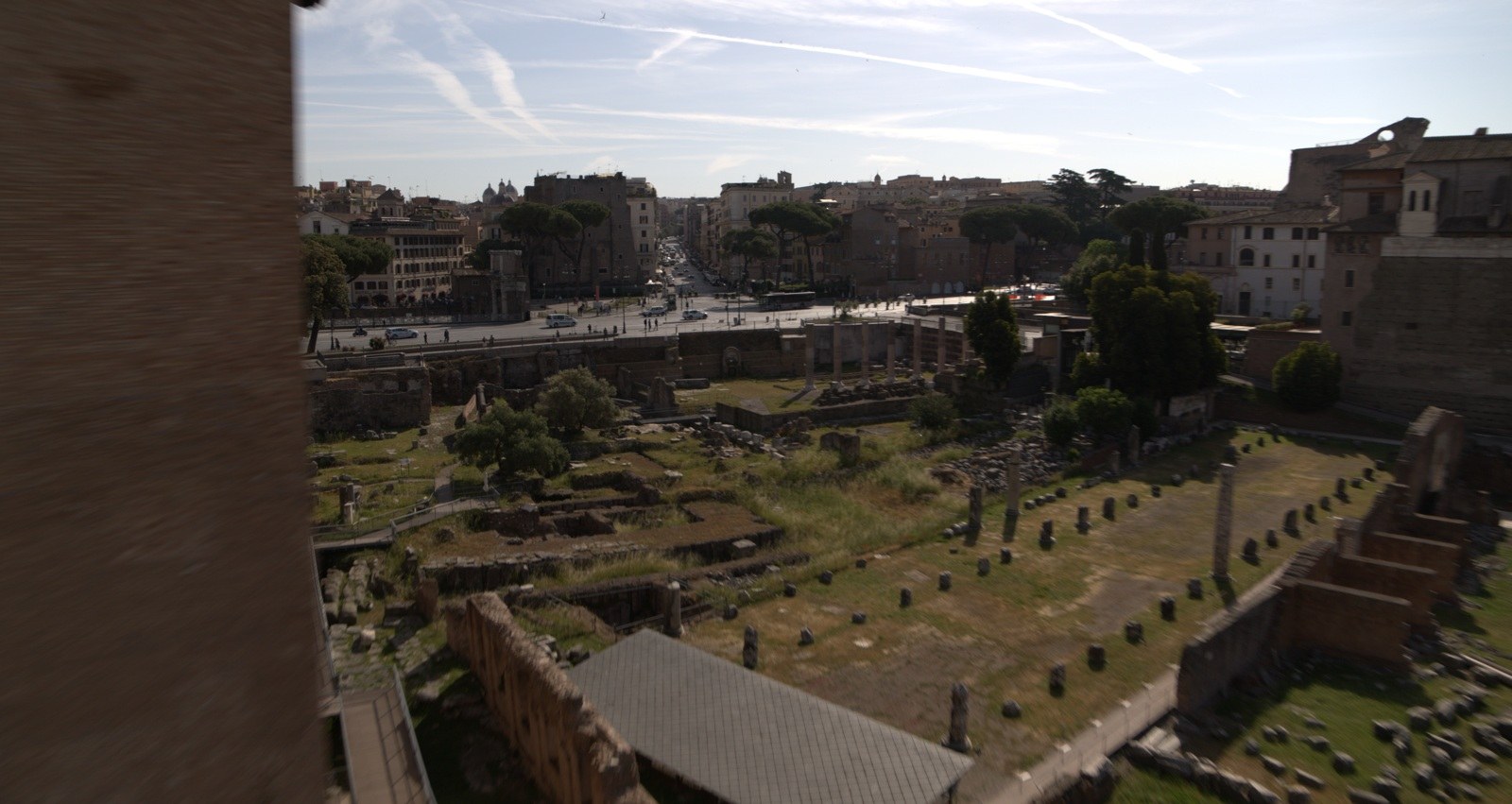
Two camera-original frames from the Rome archive show another part of this geographical work. The view approaches between buildings and then opens across the Roman Forum. The movement connects an enclosed city space with a much broader setting. These frames show the captured image before a finished-film grade.
Under five minutes to move. Under five minutes to shoot.
The team’s mobility was designed into its preparation. WarpCam® systems travelled in self-contained Pelicases with the controls, accessories and prepared batteries needed for the day. Redundancy ran through the package: aircraft, cameras and controls could be substituted within the system.
When the radio call redirected the unit, it could pack and be ready to leave in under five minutes. After arriving at the next unit, it could be ready to shoot in under five minutes. These are separate measures of packing and deployment; travel between locations sits between them.
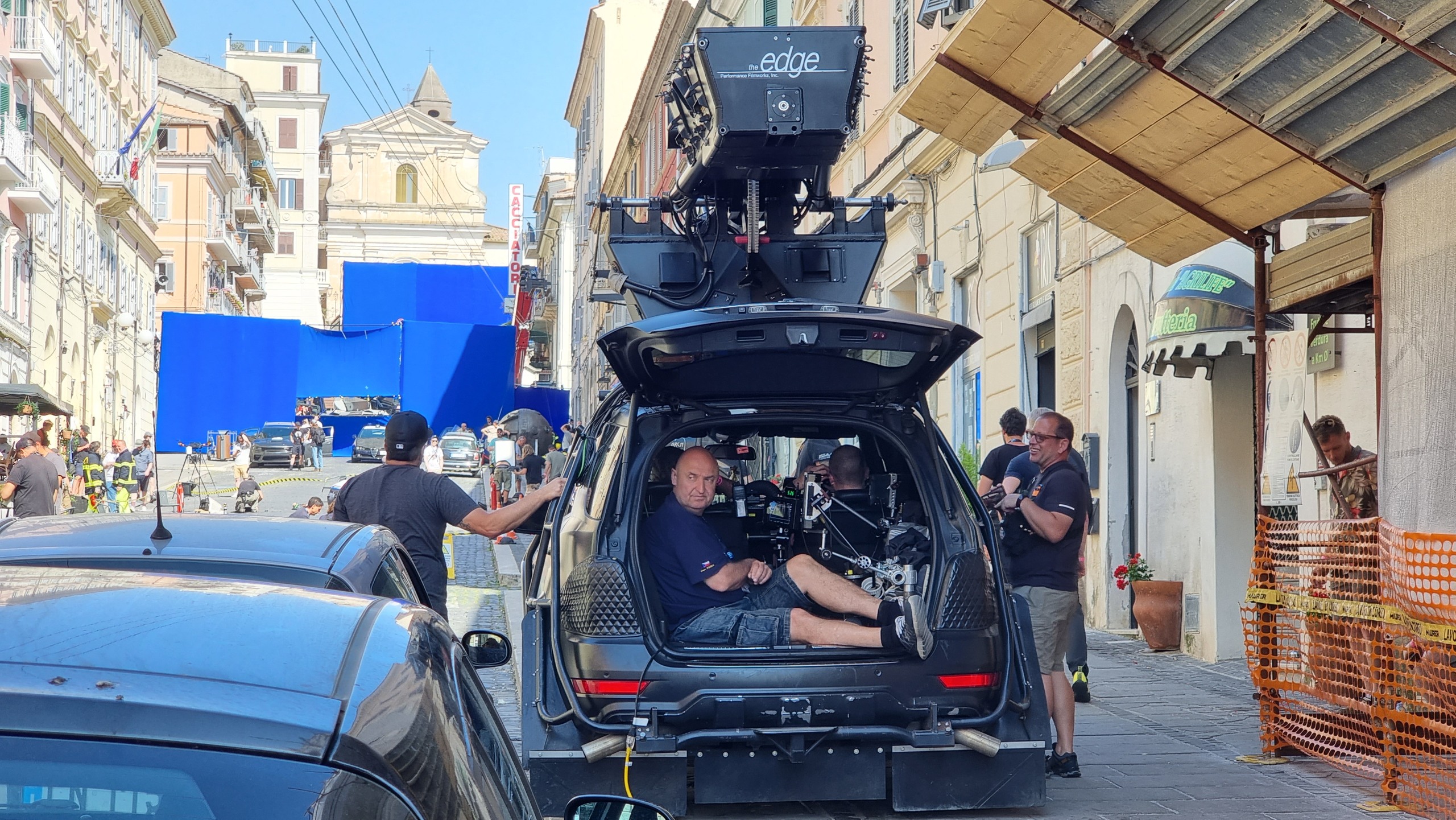
Batteries were charged overnight at the hotel so the team could operate throughout the shooting day without relying on an external power supply. The unit arrived with its working capacity already prepared.
That organisation made the creative freedom practical. Ferdi could identify a shot or accept an assignment without first rebuilding a large support structure around it. The crew knew its system, the replacement equipment was prepared and the camera could move with the people who operated it.
The production did not have to wait for WarpCam®. Readiness was part of the service: the ability to answer the next call, leave with the complete package and begin working quickly at the next assignment.
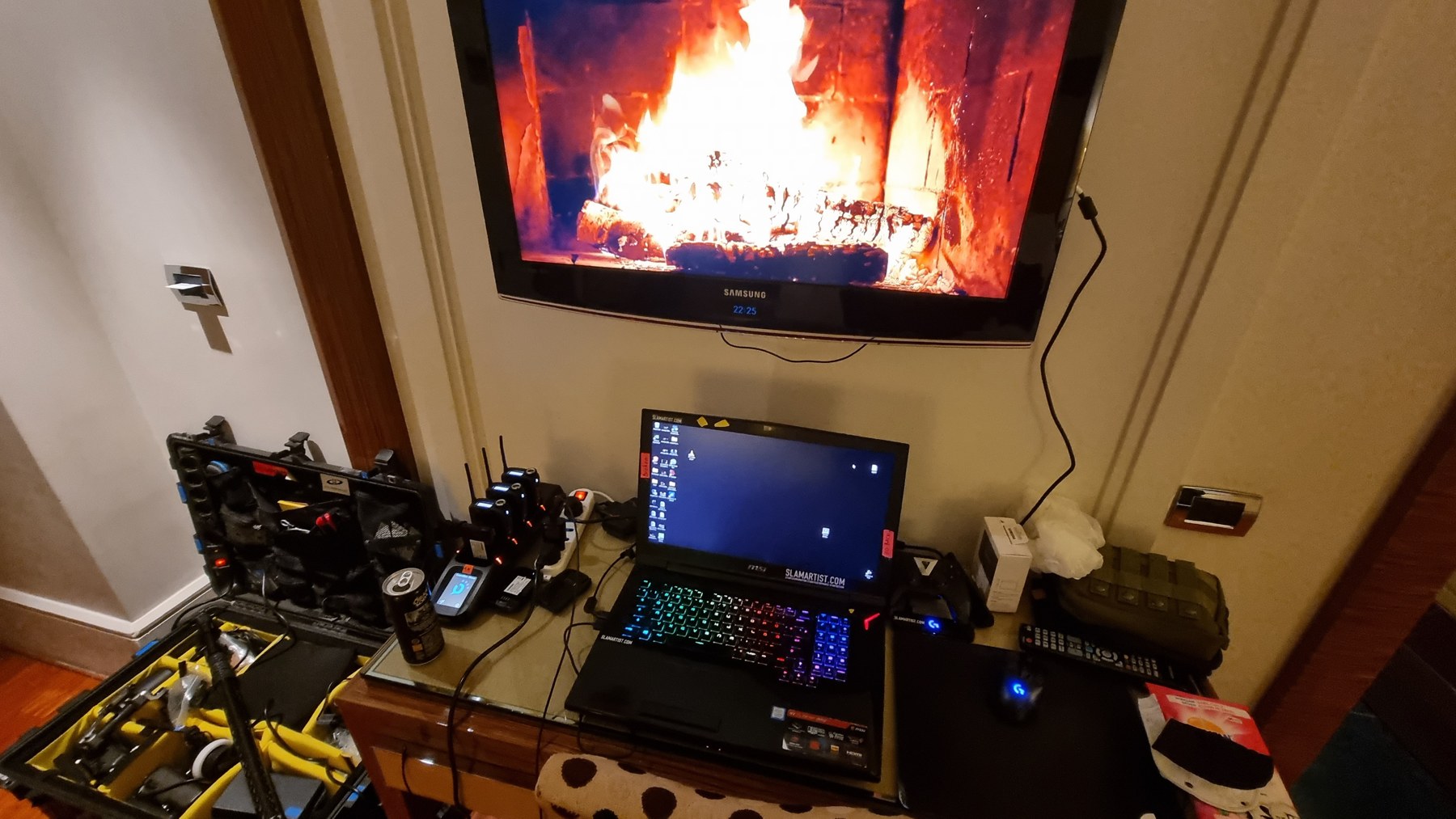
Readiness connected the whole range
A unit that changes between a drone, a ground camera car and physical operating also needs its controls, camera knowledge and power to remain available. The redundant package made those configurations part of one prepared operation. An interchangeable camera or controller could move within that system, and the crew carried the knowledge of how its parts worked together.
The hotel charging routine moved the day’s power preparation into the period before shooting. The cases moved equipment preparation into a repeatable deployment process. The two under-five-minute intervals describe what this preparation meant when the next radio assignment arrived.
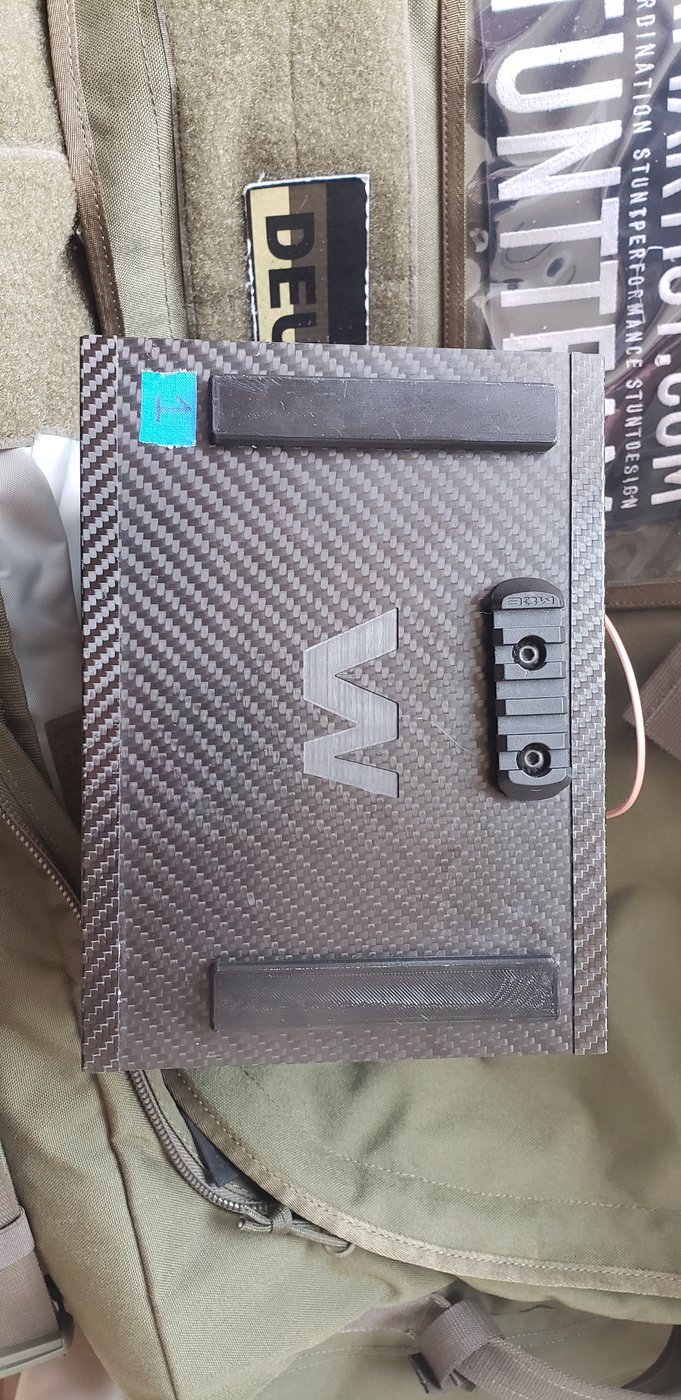
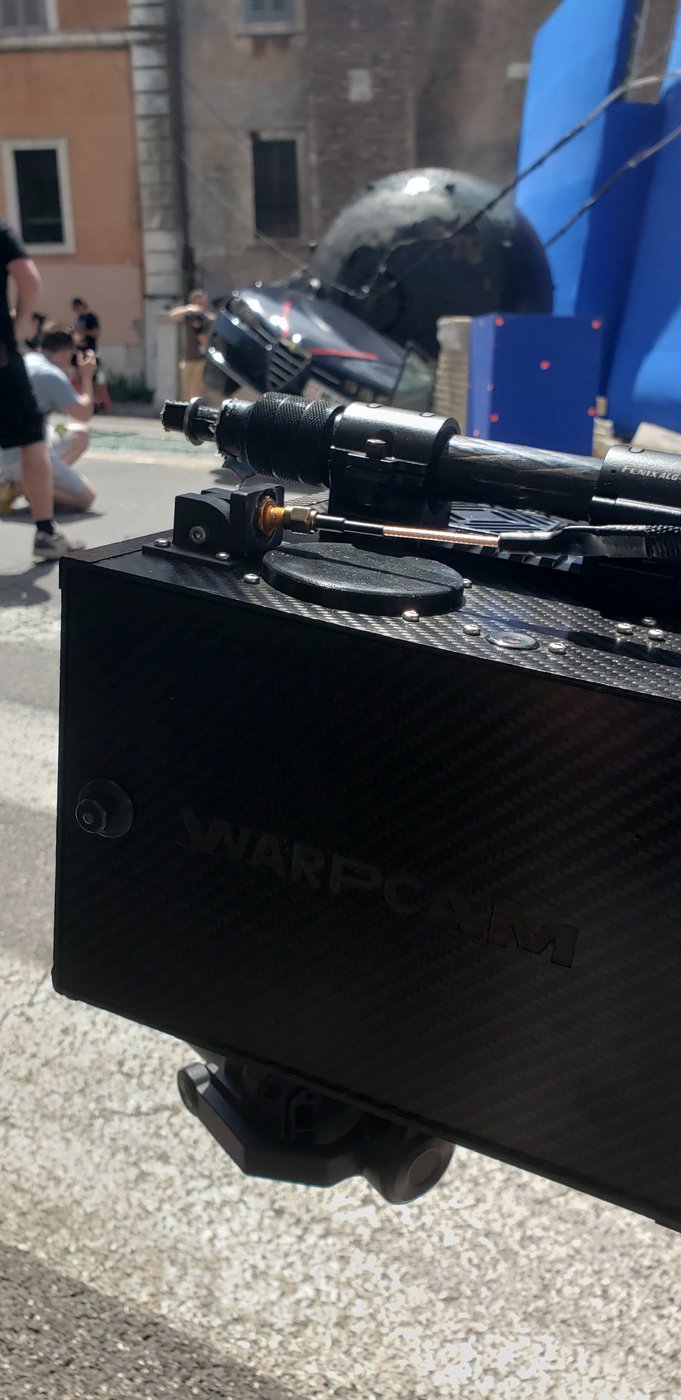
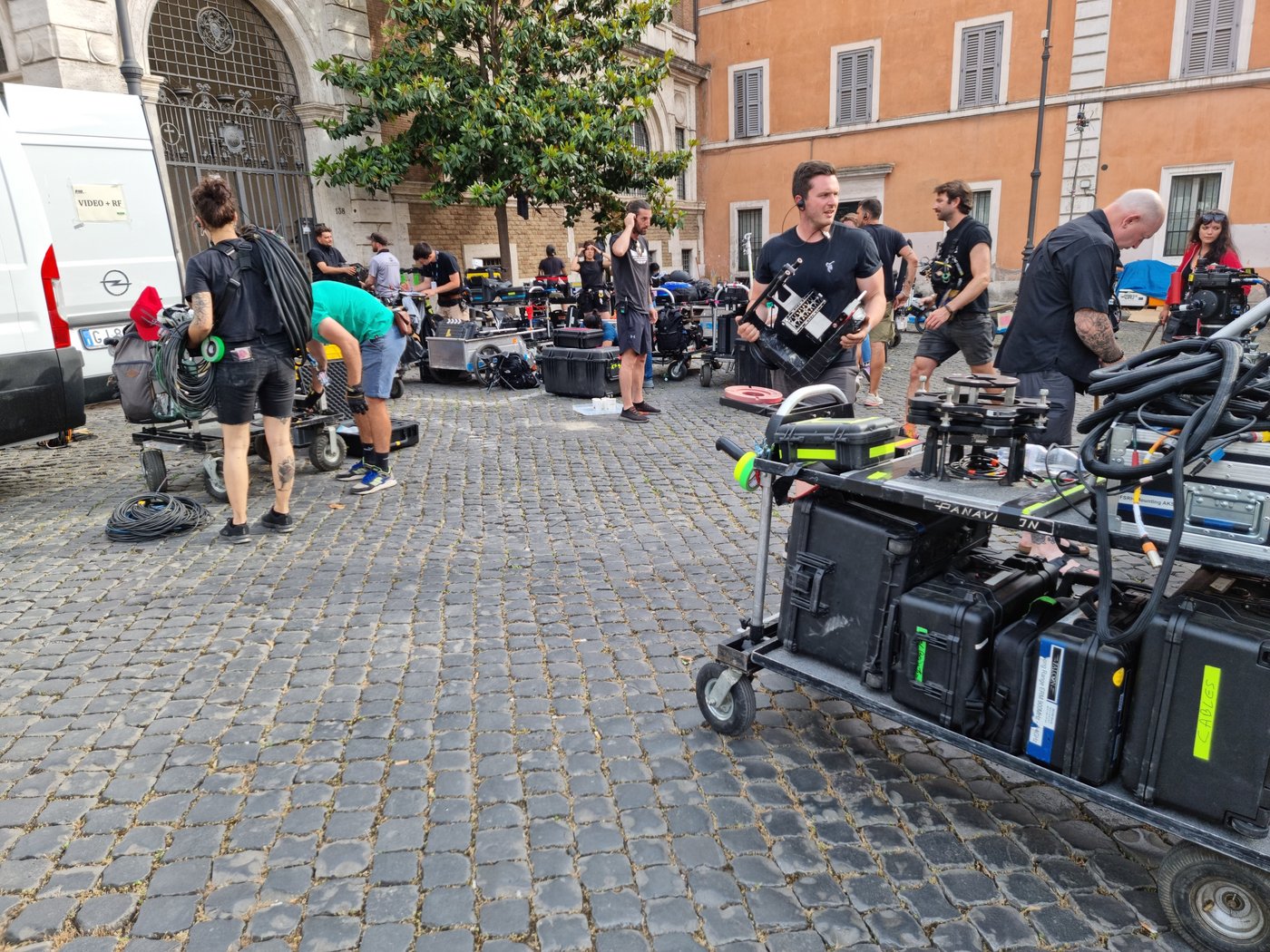
“No one waits for WarpCam®.” Ferdi Fischer, translated from his 27 November 2026 account
What productions can recognise in this case
The useful question for another production is where its own sequence encounters the same problem. A significant story beat may sit below the height of the available camera. A director may have the physical action but still need an image that gives it meaning. Several camera assignments may need to proceed across different units.
Fast X shows how Ferdi Fischer connected those questions to decisions, people and working camera systems. The chain is consistent: identify the production problem, develop the image, choose or create the means of reaching it, coordinate the team and deliver footage that serves the sequence. Its production value comes from keeping those decisions connected.
Preparation turns mobility into working capacity
The unit’s speed began before the reassignment call. Batteries were charged, equipment was organised into self-contained cases and the camera systems had interchangeable components. A move carried the people who knew those systems alongside the equipment itself.
This explains the practical significance of the two deployment timings. Packing and beginning work at the next unit were supported by decisions already made. The crew arrived with prepared power, controls and camera knowledge. The production could redirect a functioning team and retain the capability it had called for.
Delegation lets the lead contribute in two places
Ferdi could develop and brief an FPV shot, then move to an A-camera assignment while the instructed team continued. His judgement remained present in the FPV brief even when he was physically operating another camera.
For a producer, this identifies a specific benefit of booking a leader together with an established team. The production gains Ferdi’s personal operating capability and a crew able to execute the shot he has developed. The division of work creates parallel capacity within the same engagement.
Engineering can protect a story requirement
The RC work shows the value of addressing camera access during development. The story needed the audience to follow a small vehicle beneath the convoy. Ferdi’s camera car gave the DOP a way to cover that action at the required level.
The resulting capability supported the planned coverage and further shot ideas. For a director or DOP, early technical involvement can preserve a desired viewpoint and open additional ways to use it. The engineering decision becomes a creative resource through the team that operates it.
Adaptability keeps an image available
The staircase assignment provides the recovery example. Two earlier camera arrangements had failed, but the required leading image still mattered. The Floating Action Unit could change the physical solution and deliver that image.
The transferable value is the ability to reconsider how a camera reaches the shot while preserving the shot’s purpose. Ferdi’s understanding of the action, camera movement and available operating methods allowed him to connect the creative problem with another executable approach.
The selected images show what the production received
All of Ferdi’s A-camera shots are in the Fast X trailers, and the trailers represent every operating mode of the Floating Action Unit’s work. That outcome gives the operating model a visible result across Sony VENICE A-camera, gimbal FPV, handheld and motorcycle work, hard-mounted vehicle positions and RC coverage.
For another production, the trailer examples and the corresponding production records make the conversation specific: which image does the sequence need, what responsibility should Ferdi carry, and which team and system will allow him to deliver it?
Ten production problems and the corresponding Fast X solutions
Each row connects a production need to Ferdi’s decision, the deployed team or system, the evidence that explains it and a comparable brief for another film. The final column translates each example into a practical hiring scenario.
| Production problem | Ferdi’s decision, system and team | BTS or monitor evidence and screen result | Creative or production value | Comparable hiring scenario |
|---|---|---|---|---|
| 1. A small object performs a major story action | Develop a low WarpCam® RC platform that can photograph the picture RC vehicle from its own level, with leading, following and parallel coverage. | The camera-car photographs and production monitor connect the physical viewpoint to the RC sequence. Explore the narrative RC work. | The audience can follow the plot action within the larger convoy sequence. Engineering creates access to the information the scene needs. | Bring Ferdi into development when a vehicle, prop or small moving subject requires a viewpoint that the planned camera package cannot readily occupy. |
| 2. The flight and the frame need different movements | Integrate Johnny FPV’s flying with independently operated WarpCam® gimbal framing inside Ferdi’s shot design and team coordination. | Aircraft preparation, remote operating and the resulting aerial images show the relationship between platform movement and composition. Explore gimbal FPV. | The camera can attend to the story subject through the flight. The pilot, camera operator and focus work contribute to one intended image. | Brief Ferdi when an aerial move must carry a reveal, changing composition or precise narrative relationship through a vehicle or action sequence. |
| 3. A large event needs a memorable composition | Conceive the café image as connected layers: people being photographed, an escaping Lamborghini and the Humvee explosion, shaped through camera movement and slow motion. | The multiple-view source connects the foreground arrangement with the photographed event. The composition appears across the Fast X trailers. Explore the café image. | The event gains a distinct point of view. Human behaviour and large-scale action become part of the same readable image. | Involve Ferdi in shot development when the action exists but the sequence needs a defining image, a visual contrast or a stronger relationship between its elements. |
| 4. The production camera needs an action specialist | Ferdi takes the Sony VENICE A-camera assignment himself, applying his camera-operating and stunt experience to demanding close-action positions. | The exact operating photographs and the recovered voice-over edit connect Ferdi at the production camera with café footage, BTS and filmed monitor playback. All of his A-camera shots appear across the trailers. Explore A-camera operating. | The production gains his physical and photographic judgement while retaining the camera configuration chosen for that assignment. | Engage Ferdi for action-camera operating when movement, proximity and awareness of the physical scene are central to obtaining the intended shot. |
| 5. The camera needs to travel with motorcycle action | Use Ferdi’s physical operating from the passenger position, supported by the coordinated WarpCam® team, for leading and following images. | The motorcycle BTS and camera-result comparison connect the operator’s moving position to the image. Explore physical operating. | The audience shares the movement of the chase. The viewpoint can be developed around the relationship between the camera and the riders. | Discuss a physical operating brief when the sequence needs a travelling viewpoint that remains closely connected to performers or picture vehicles. |
| 6. Vehicle coverage needs several distinct perspectives | Combine hard-mounted WarpCam® positions inside and outside vehicles with the unit’s other camera configurations, selecting each position around its shot. | The production account establishes the vehicle-mounted assignments. The official trailers provide the finished-film reference for this part of the unit’s work. Explore vehicle configurations. | Camera positions can express different relationships to the same action while remaining within a shared team and working method. | Brief an integrated camera unit when a chase requires vehicle-mounted views alongside handheld, aerial or ground-level material within the same sequence. |
| 7. The planned capture method has failed | Preserve the required staircase leading image and change to a pole-mounted WarpCam® operated from the RZR’s passenger position. | The production account explains the two failed arrangements and the successful change. The staircase comparison and full wider BTS show the coverage and physical setting. Explore the recovery. | The unit delivers the outstanding image and rescues the assignment. Its adaptability provides another practical route to the same creative requirement. | Bring Ferdi into a stalled shot when the production needs a revised camera approach, with the image and the circumstances assessed together. |
| 8. Two camera tasks need to continue in parallel | Brief the FPV team so it can execute the agreed shot, then move Ferdi to a separate A-camera assignment. | Team operating material explains the delegated roles; the FPV and A-camera results show the two forms of contribution. Explore the parallel working model. | Ferdi’s personal operating and his team’s capability can serve different assignments without making every camera action dependent on his physical presence. | Plan a unit-led engagement when several camera demands overlap and the production needs both a creative lead and a trained team capable of executing his brief. |
| 9. The sequence needs geography as well as proximity | Use the unit for the Rome establishing imagery, including the fortress view, alongside its close and low camera work. | Two camera-original Roman Forum frames show an approach and reveal within the Rome work. The separate fortress location photograph accompanies the opening-coverage account. Explore the geographical coverage. | The audience receives both the scale of the setting and the specific viewpoints needed to understand action within it. | Include establishing and connective images in the camera brief when a specialist unit can contribute to the visual continuity of an entire sequence. |
| 10. The next assignment is with another unit | Move a prepared team and self-contained Pelicases, with interchangeable systems and batteries charged for the day. | The hotel preparation photograph shows the night setup; case and location images show the equipment footprint. The production account supplies the separate packing and arrival-to-ready timings. Explore deployment. | The unit can accept reassignment without depending on a new power connection or assembling its camera knowledge and support from separate sources. | Use the Floating Action Unit model when one sequence is divided between units, locations or changing assignments and the camera team needs to remain mobile. |
Turn the production problem into a useful brief
A productive first conversation begins with the scene. Explain what the audience must understand, what the image should make them feel and which part of the intended camera movement is difficult to achieve. Include the existing visual references and the production circumstances that will affect the shot.
Then identify the responsibility the production needs Ferdi to carry: developing the shot, creating a camera solution, leading a Floating Action Unit, personally operating a demanding camera position, or combining those tasks. The Fast X examples provide a shared vocabulary for that discussion.
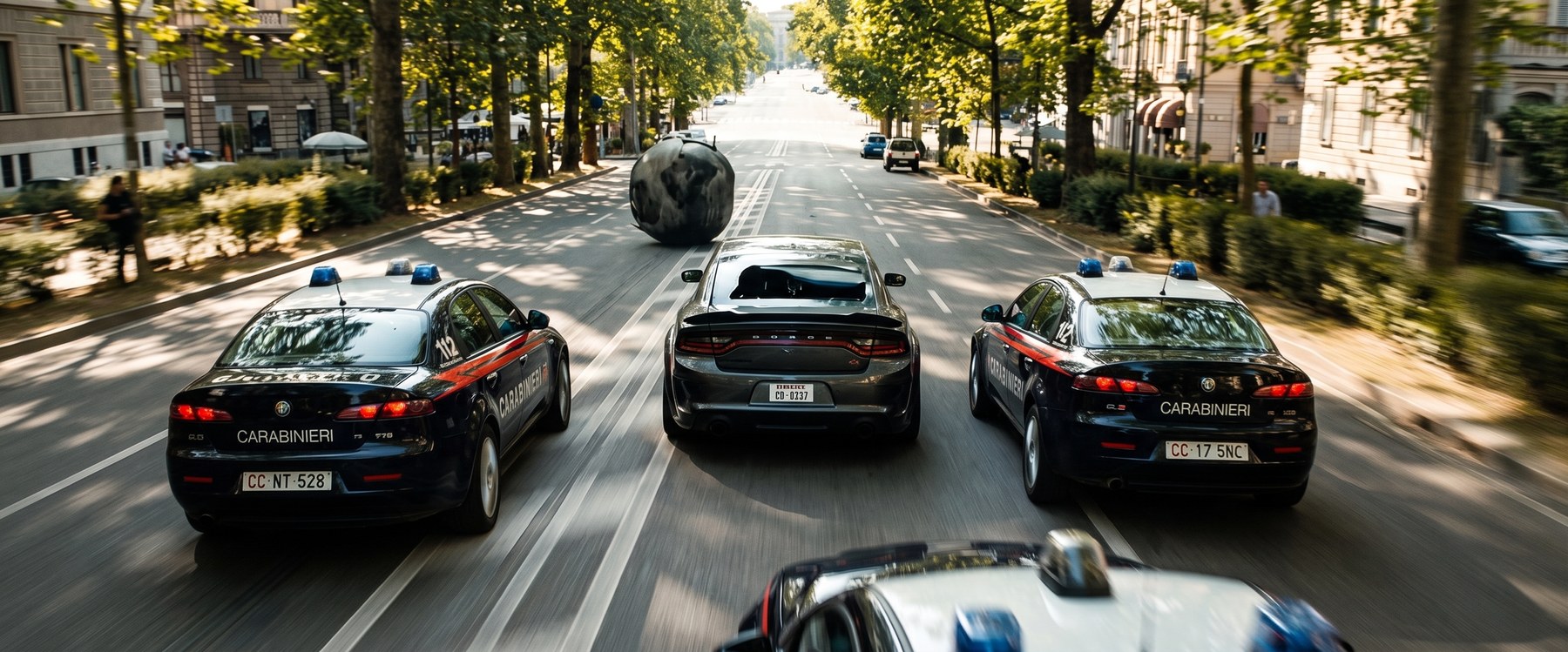
Bring the DOP’s and DIT’s image requirements into that brief: the production camera to match, representative tests, the intended live viewing transform and the post-production handover. The Fast X image-integration chapter explains how the 6K WarpCam® work sat beside the production’s Sony VENICE image.
For producers, this clarifies the engagement. For directors, it keeps the creative requirement visible. For DOPs, it connects the image to the operating method. The names describe distinct responsibilities: Ferdi Fischer is the creative and technical lead; the Floating Action Unit is the team model; WarpCam® is the camera ecosystem; FPV, RC, handheld, pole and vehicle mounts are its deployed configurations. A-camera operating is an additional personal capability demonstrated with the production’s Sony VENICE.
Within this working method, a Virtual Camera Operator remotely controls the physical camera’s framing, while the Physical Camera Operator moves it through the scene. The pilot moves the aircraft and the Focus Puller maintains the required focus. WarpSpeed® identifies the gimbal-FPV approach further established through this collaboration. Those distinctions connect each role and system name to a production function.
What Fast X demonstrates
The distinctive operating model becomes visible when the assignments are considered together. Ferdi conceived a trailer image, developed a camera car around a narrative requirement, coordinated gimbal FPV, operated from motorcycles and with the production’s A-camera, and led a crew that could move between units with its own equipment and power.
Each responsibility strengthened the others. Knowledge of physical action informed the camera movement. Engineering gave a shot somewhere to go. An instructed team could continue working while Ferdi took another assignment. Prepared, interchangeable systems kept the unit mobile.
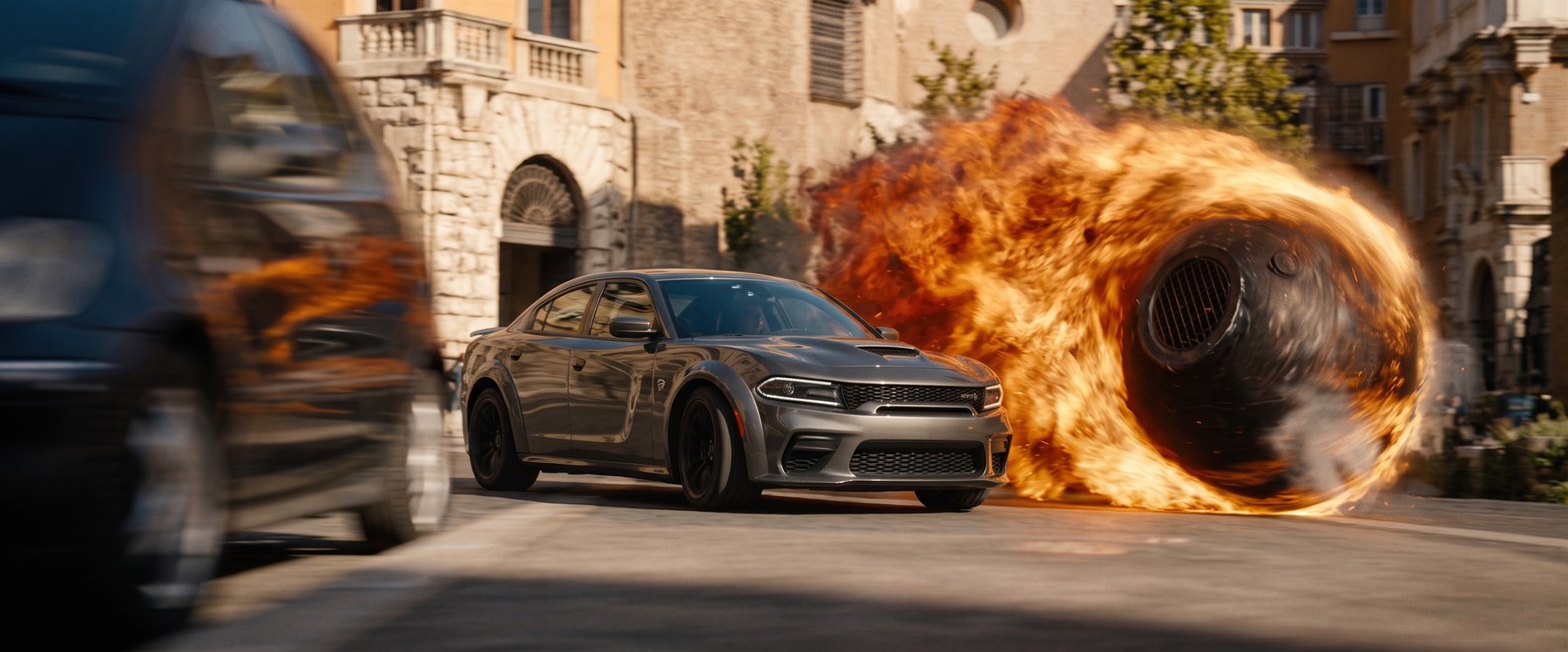
This is the Floating Action Unit that Ferdi Fischer and SlamArtist.com developed: a distinct combination of people, creative judgement and camera systems organised around the shot. Fast X shows what that combination can contribute inside a major franchise production.
The archive brings those decisions into view through production photographs, making-of clips and selected screen results. Individual clips retain their own context: finished film material, trailer imagery and production previews are identified separately wherever that distinction is known.
SLAMARTIST.COM
Bring the story.
Bring Ferdi in early.
Action direction, specialist camera development and a mobile operating team can be planned together around the sequence.
Explore Ferdi’s action-production work ↗ Contact Ferdi FischerQuestions producers, directors and DOPs can answer from Fast X
- What did Ferdi Fischer lead on Fast X?
-
Ferdi led his own Floating Action Unit. His responsibilities included shot design and direction, camera development, coordination of the unit’s operators and FPV work, WarpCam® operating and personal A-camera assignments. The unit worked primarily within the production’s extensive Second Unit and moved to other assignments as required.
- What is a Floating Action Unit?
-
It is Ferdi Fischer and SlamArtist.com’s mobile team model for connected action-camera work. On Fast X, approximately seven people combined physical and virtual camera operating, focus, assistants, camera preparation and FPV. Prepared equipment and shared working knowledge allowed that team to move between production units.
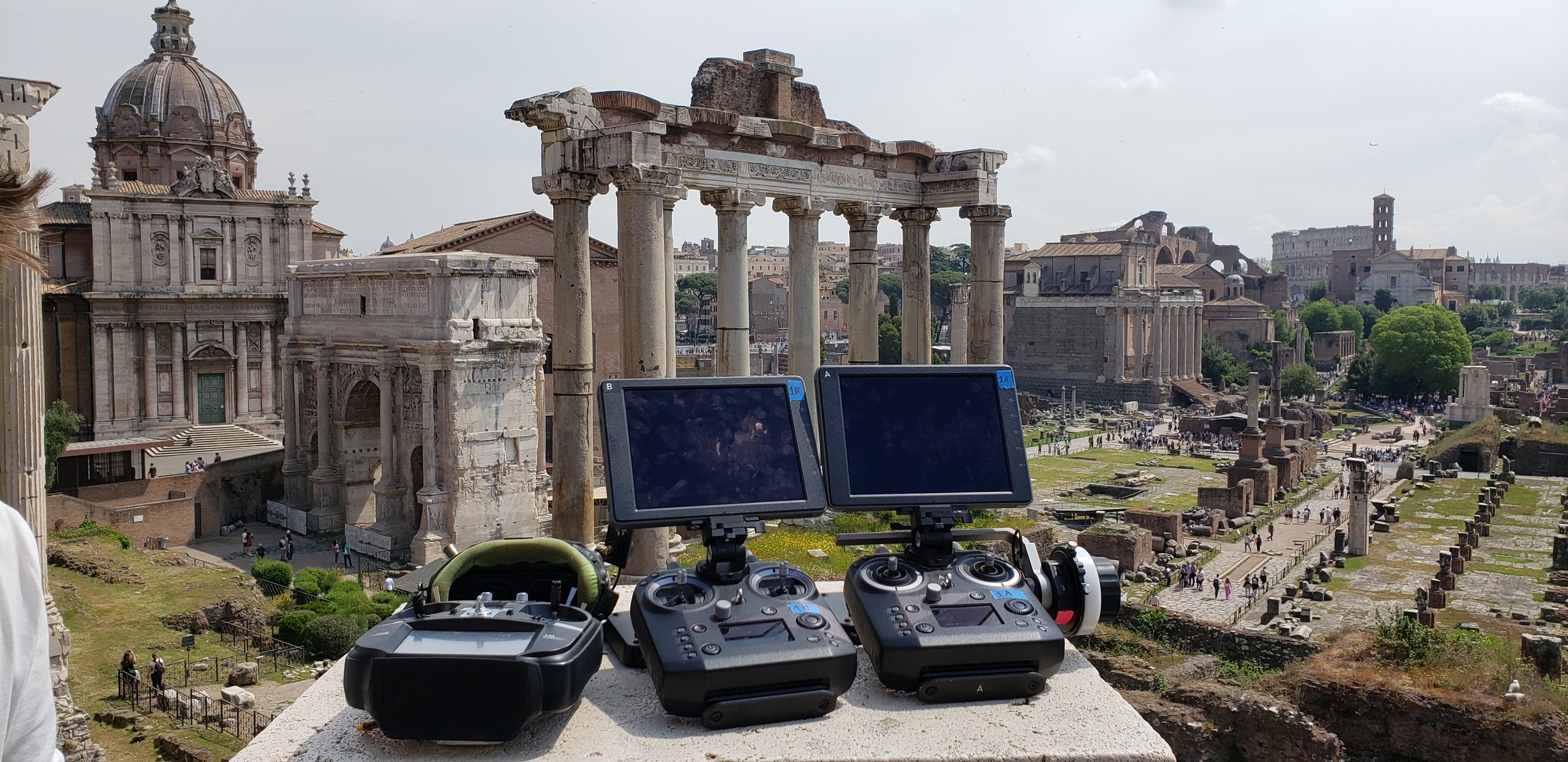
- Why was a camera car developed specifically for the film?
-
The story included a small RC vehicle operating beneath a larger convoy vehicle. The DOP needed coverage at that level. Ferdi developed a low WarpCam® camera car so the audience could follow the story vehicle through leading, following and parallel views. The narrative requirement drove the engineering.
- How did Johnny FPV fit into the Floating Action Unit?
-
Johnny FPV flew the WarpCam® gimbal configuration within Ferdi’s unit. Ferdi coordinated the shot design and the relationship between flight and independent camera framing. Their preparation included work together in Los Angeles. The pilot’s movement and the camera operator’s composition contributed to the same narrative image.
- Could Ferdi also operate the production’s own camera?
-
Yes. He repeatedly operated the production’s Sony VENICE 2, including a detached-sensor configuration, on demanding A-camera assignments. His team could continue an instructed FPV shot while he took another camera position. His contribution therefore included both the WarpCam® ecosystem and operating the production camera.
- Where can the range of this work be seen in the trailers?
-
All of Ferdi’s A-camera shots appear in the Fast X trailers. The trailers also include every Floating Action Unit mode: Sony VENICE A-camera work, gimbal FPV with Johnny FPV, handheld and motorcycle operating, hard-mounted vehicle positions and RC coverage. Each mode represents a different production task within the wider contribution.
-
The café composition connects people being photographed in the foreground with an escaping Lamborghini and an exploding Humvee behind them. Ferdi conceived the arrangement, people’s positions, camera movement and slow-motion treatment. The resulting trailer image makes his creative contribution visible beyond the choice of camera equipment.
- What do the two under-five-minute figures measure?
-
One measures the time from the reassignment call to being packed and ready to leave. The other measures readiness to shoot after arriving at the next unit. Actual travel sits between them. Prepared cases, interchangeable equipment and batteries charged overnight supported those two stages on Fast X.
- What does the staircase example demonstrate?
-
After two earlier camera arrangements failed, the Floating Action Unit delivered the required leading image using a pole-mounted WarpCam® from the RZR’s passenger position. It demonstrates a team able to preserve the creative requirement while changing the physical camera solution, with the result serving the same production assignment.
- When should another production involve Ferdi?
-
Involve him when shot design, camera access, physical operating or unit coordination are central to the sequence. Early involvement allows camera development to respond to story needs, as the RC work did. A production can also brief a defined operating assignment, a mobile unit or a specific camera problem that needs a new solution.
From the set to the official Fast X trailers
All of Ferdi Fischer’s A-camera shots appear in the Fast X trailers. Every operating area of his Floating Action Unit is represented across those trailers. That includes his Sony VENICE A-camera work, the gimbal-FPV collaboration with Johnny FPV, WarpCam® handheld and motorcycle operating, vehicle hard mounts and RC camera coverage.
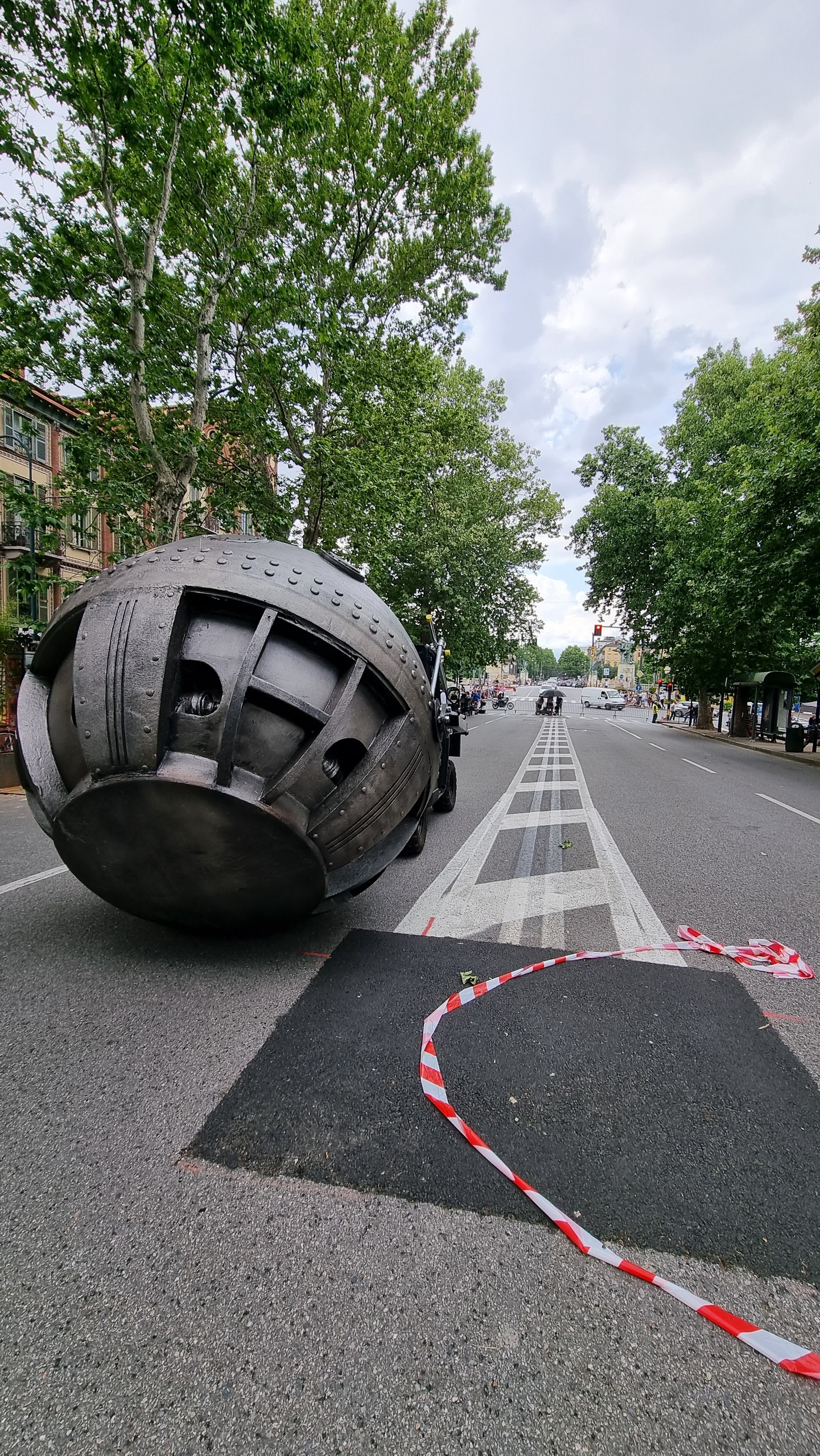
Five places to connect the archive with the trailers
Watch the linked archive comparison, then find the corresponding image in the named trailer copy. The time references below belong to those production or editorial portfolio copies. The official studio players follow the table.
| Image to find | Start with the production material | Published trailer copy | Source-local time |
|---|---|---|---|
| The café’s foreground-photographer composition | The four-view café comparison, result band around 5–6 seconds; also the recovered operating / shot / monitor edit. | Final Trailer — Freefolk copy ↗ | 01:39.27–01:40.06 |
| The RC vehicle beside and beneath the truck | The RC comparison, opening camera-result band. Follow the small vehicle coming towards the low camera beside the full-size truck. | Final Trailer — Freefolk copy ↗ | 02:21.31–02:23.06 |
| The ball’s descent from the bridge into the river | The bridge FPV comparison, camera-result band around 2.7–4.6 seconds. The BTS view also reveals the aircraft. | Trailer 2 — AV Squad’s “Last Ride” copy ↗ | 00:38.79–00:39.96 |
| The café composition in Trailer 2 | The café comparison: foreground photographer, patrons, moving Lamborghini and the vehicle event behind them. | Trailer 2 — AV Squad’s “Last Ride” copy ↗ | 01:04.48–01:05.27 |
| The café vehicle-roll passage in the main trailer | The café comparison: the later, tighter view of the rolling vehicle through the café’s trees and umbrellas, with patrons in the foreground. | Main trailer — editorial portfolio copy ↗ | 01:22.58–01:23.42 |
The Freefolk production page and AV Squad campaign page provide the first two portfolio sources. The main-trailer reference is an editorial contributor’s portfolio upload. Each comparison identifies the visible passage; Ferdi’s shot and operating responsibilities are explained in the preceding chapters.
The official trailers below complete the viewing sequence: first the explanation, then the making-of material and camera comparisons, then the finished film presentation. Use the earlier chapter links to return to a system or operating method while watching.
FAST X | Official Trailer
By this point in the case study, those images have a production context. The low RC viewpoint connects to a camera platform developed for a story requirement. The aerial movement connects to flight and independently controlled framing. The close physical images connect to operating positions, stunt understanding and a prepared team. The trailer images are the visible outcome of those decisions.
FAST X | Official Trailer 2
The strength of this outcome lies in its range. The unit’s contribution reached the film’s public-facing images through several different operating methods. A producer considering the Floating Action Unit can follow that range back to specific capabilities: creative shot development, engineering for a narrative requirement, coordinated flight and camera work, experienced physical operating, parallel execution and rapid deployment.
FAST X | Final Trailer
The official players use an internet connection. Each has a direct link to the original official upload.
Ferdi Fischer’s Floating Action Unit for Fast X
Ferdi Fischer: Head of Floating Action Unit; shot design and direction; WarpCam® development and operating; A-camera operating.
Johnny FPV: FPV pilot within Ferdi Fischer’s Floating Action Unit.
Danny Leavitt: WarpCam® camera operating.
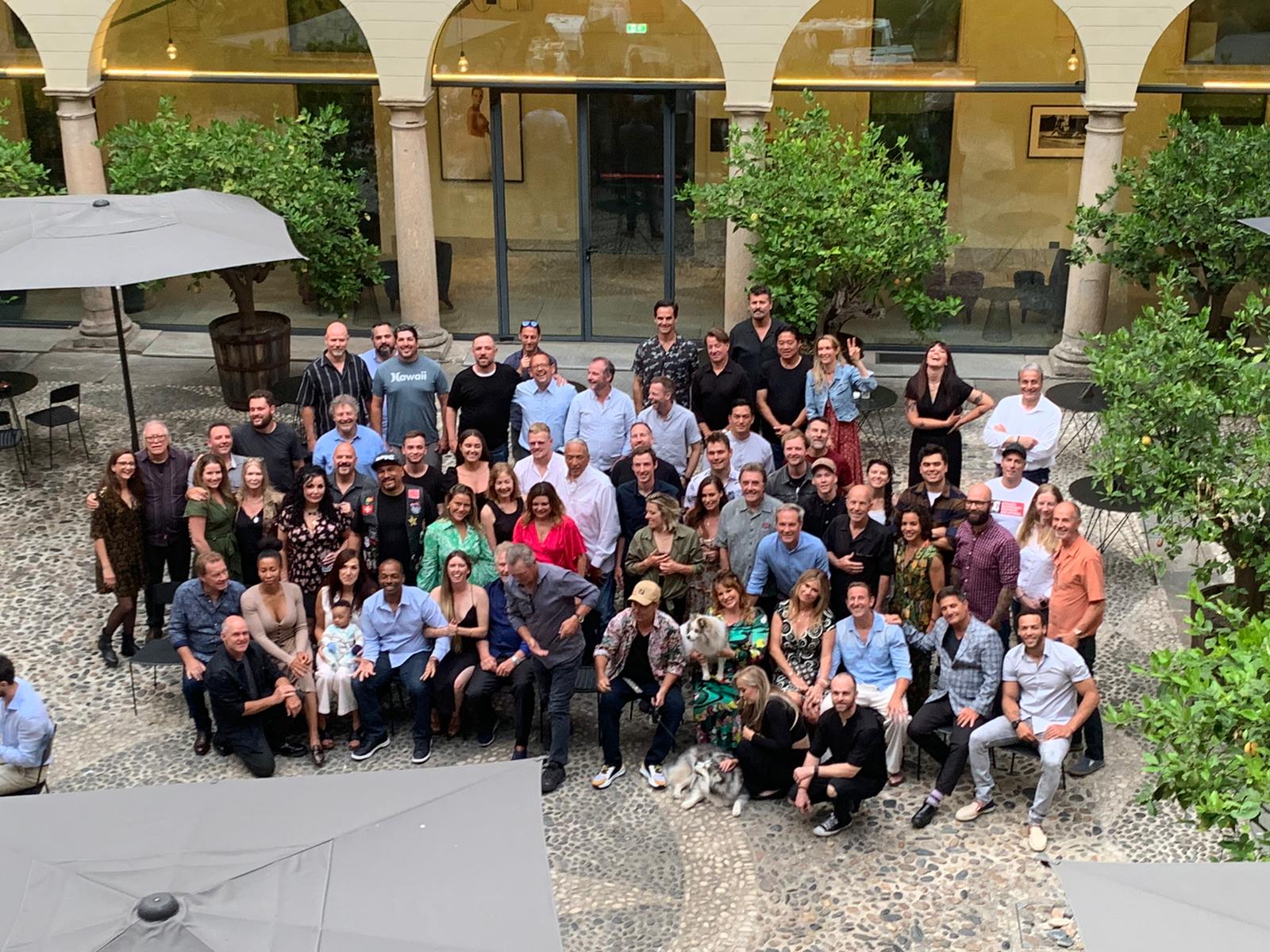
Additional team members: Gregor Frenzel, Bruno Witt and Martin Foglia.
Production: Universal Pictures. Italian executive production: Wildside.