Commercial Campaign · 2016
Stunt Coordination / Creative Design
A moving ski ramp. A Porsche Macan. The creative work behind the stunt.
Project facts
- Campaign
- Dunlop — Ski Jump
- Format
- Commercial campaign
- Year
- 2016
- Location
- Snow Dome Bispingen, Germany
- Director
- Kit Lynch-Robinson
- Director of Photography
- Pascal Rémond
- Ferdi’s contribution
- Stunt coordination, creative stunt design, ramp concept and design, team leadership, preparation and WarpCam® camera operation.
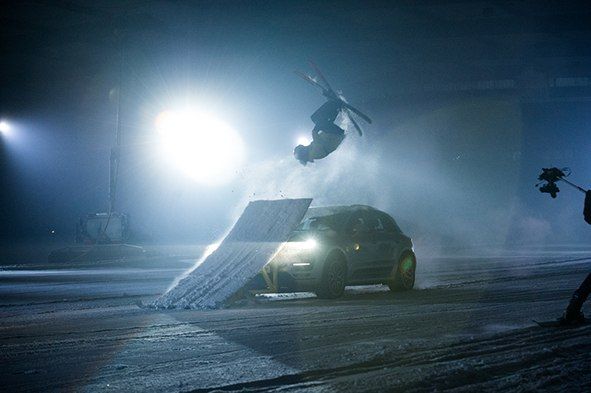
A Porsche climbs a snow-covered slope. A skier approaches from above. Mounted in front of the vehicle is a purpose-built ramp that sends the skier over the car.
For Dunlop’s Ski Jump campaign, Ferdi Fischer developed the physical execution of that advertising idea through creative stunt design, an original articulated ramp, vehicle and performer selection, his stunt team and moving WarpCam® shots.
Campaign Film — Extended Version
The work started long before the jump
I was booked as the stunt coordinator. The starting idea was clear: a car would drive uphill with a ramp mounted in front of it, while a winter sports performer approached from above and jumped over the vehicle.
Turning that idea into a shot meant working through a connected set of decisions. Which vehicle could do it? What kind of slope would work? Should we shoot outdoors or inside a snow hall? Which skier could perform the jump? And how would the vehicle, ramp, performer and camera work together to make the idea read on screen?
Those questions sat at the intersection of stunt coordination, production, direction and cinematography. My contribution was to develop the physical execution, propose workable solutions and prepare the action with production. That included vehicle options, finding the skier, the technical recce, ramp design, rehearsals and execution on location.
Kit Lynch-Robinson directed the commercial and developed the shooting board. Pascal Rémond was the Director of Photography. Within that framework, I designed the stunt and the processes needed to perform it. My team also brought the camera technology and moving-camera capability that became part of the finished film.
That is where creative stunt coordination becomes visible: decisions made within the booked role shape what the production can actually put on screen.
Choosing the vehicle, location and performer
We selected a Porsche Macan. Its combination of all-wheel drive, off-road capability and performance suited the task, and it had the right visual presence for the commercial. Being based in Stuttgart and having access to Porsche press vehicles also played a part in the selection.
We had the vehicle weeks before the shoot. That gave us time to prepare it, develop the ramp around it and test the combination. The car was part of the stunt design: it had to work with the construction and deliver the image the campaign needed.
The location decision was developed with production. After considering the options, we worked at Snow Dome Bispingen. The technical recce and preparation on the actual slope were part of that process. A solution developed in the workshop still had to work in the conditions we would encounter on the day.
I also found and selected the skier, Torge Nagel. Our work concerned the jump and his movement throughout the sequence: his approach, how that approach would read on camera and how it connected with the car’s movement and the planned viewpoints.
Daniel Leavitt drove the Macan as the precision driver in my team. The vehicle and performer work had to be coordinated as one sequence.
The design on the workshop floor
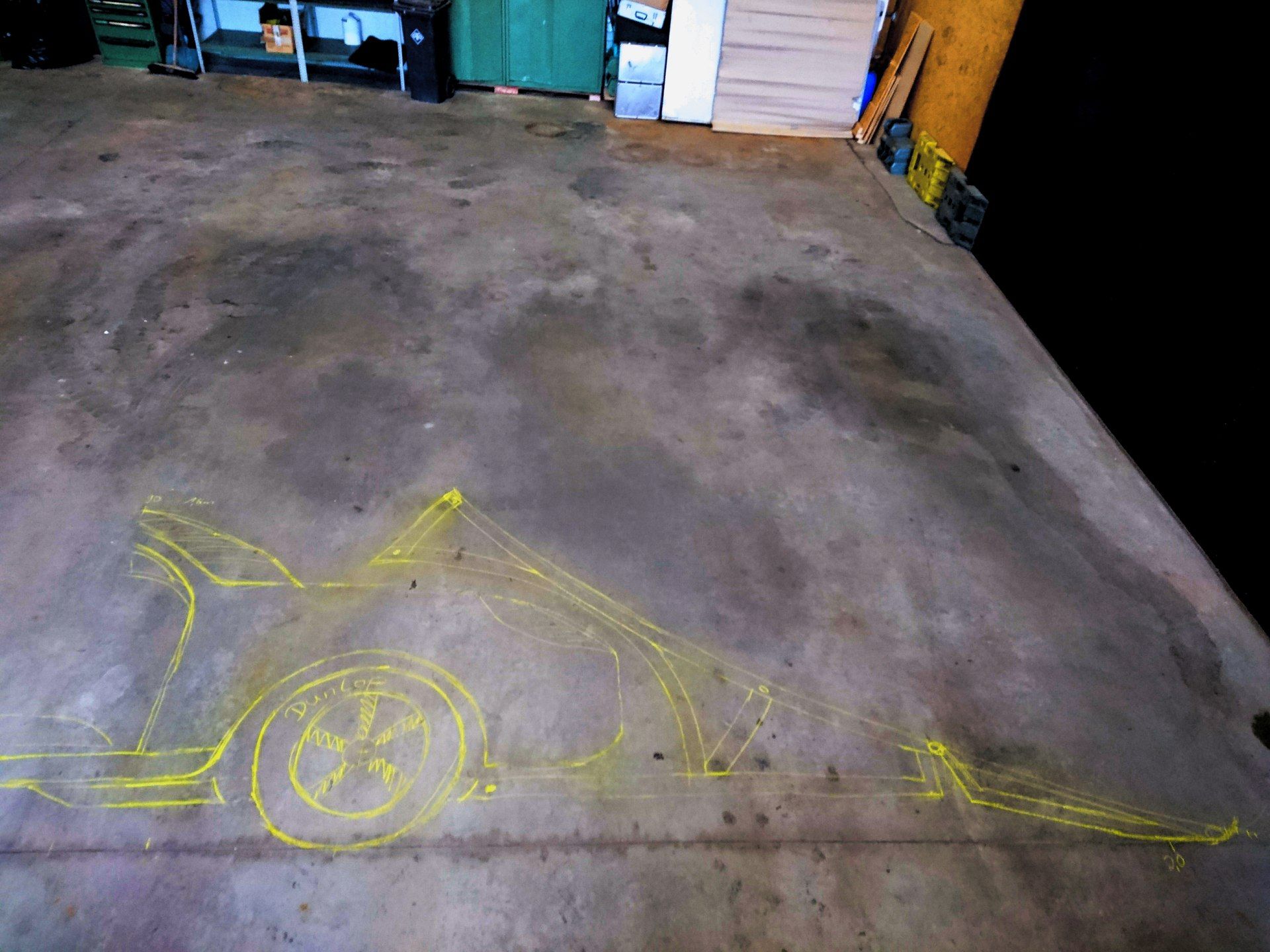
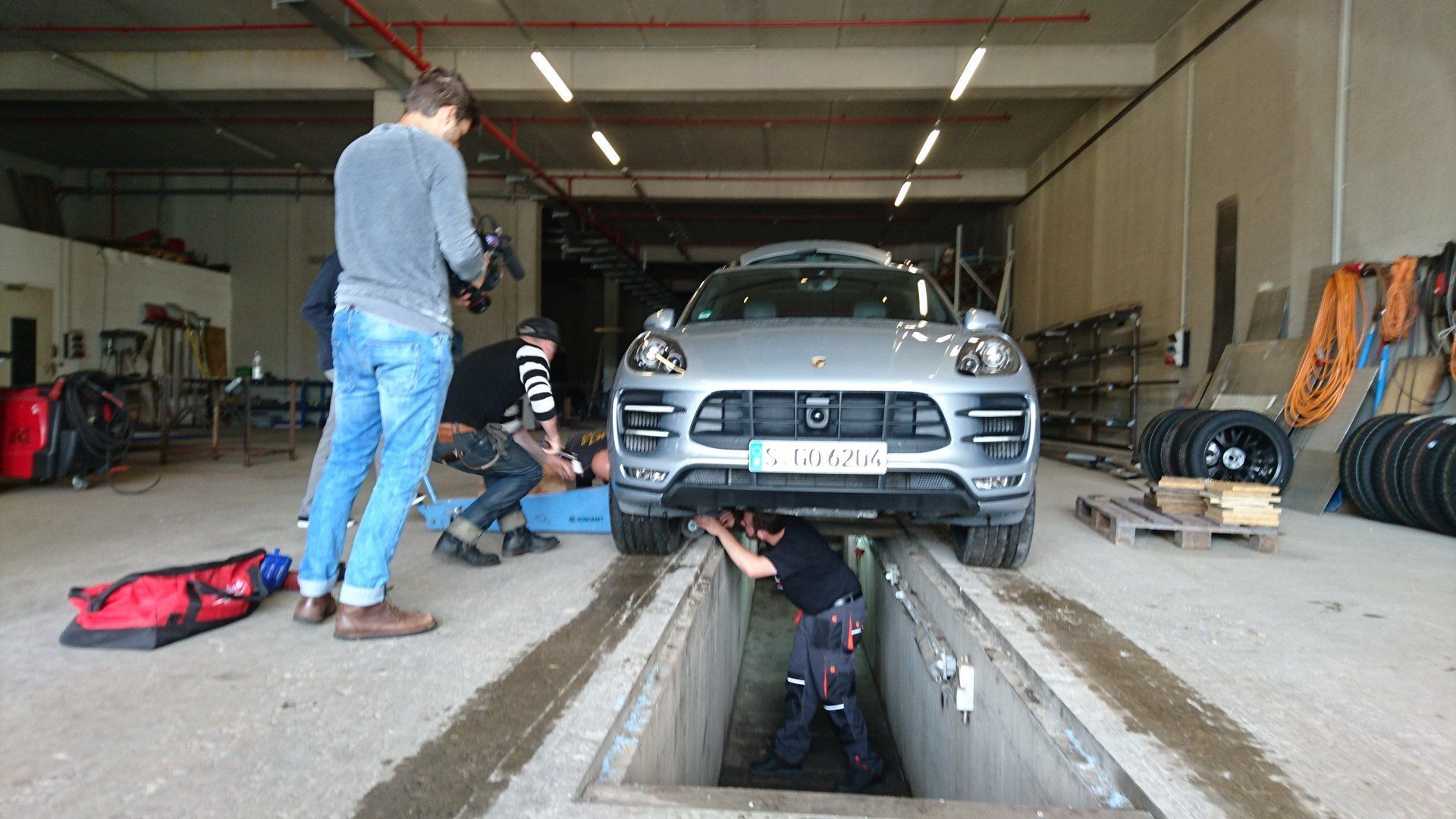
I conceived and designed the entire ramp. To communicate the idea to my stunt technician, Joachim “Joe” Bauer, I drew the vehicle and ramp profile on the workshop floor. Joe and the workshop team then fabricated and built the construction to my design.
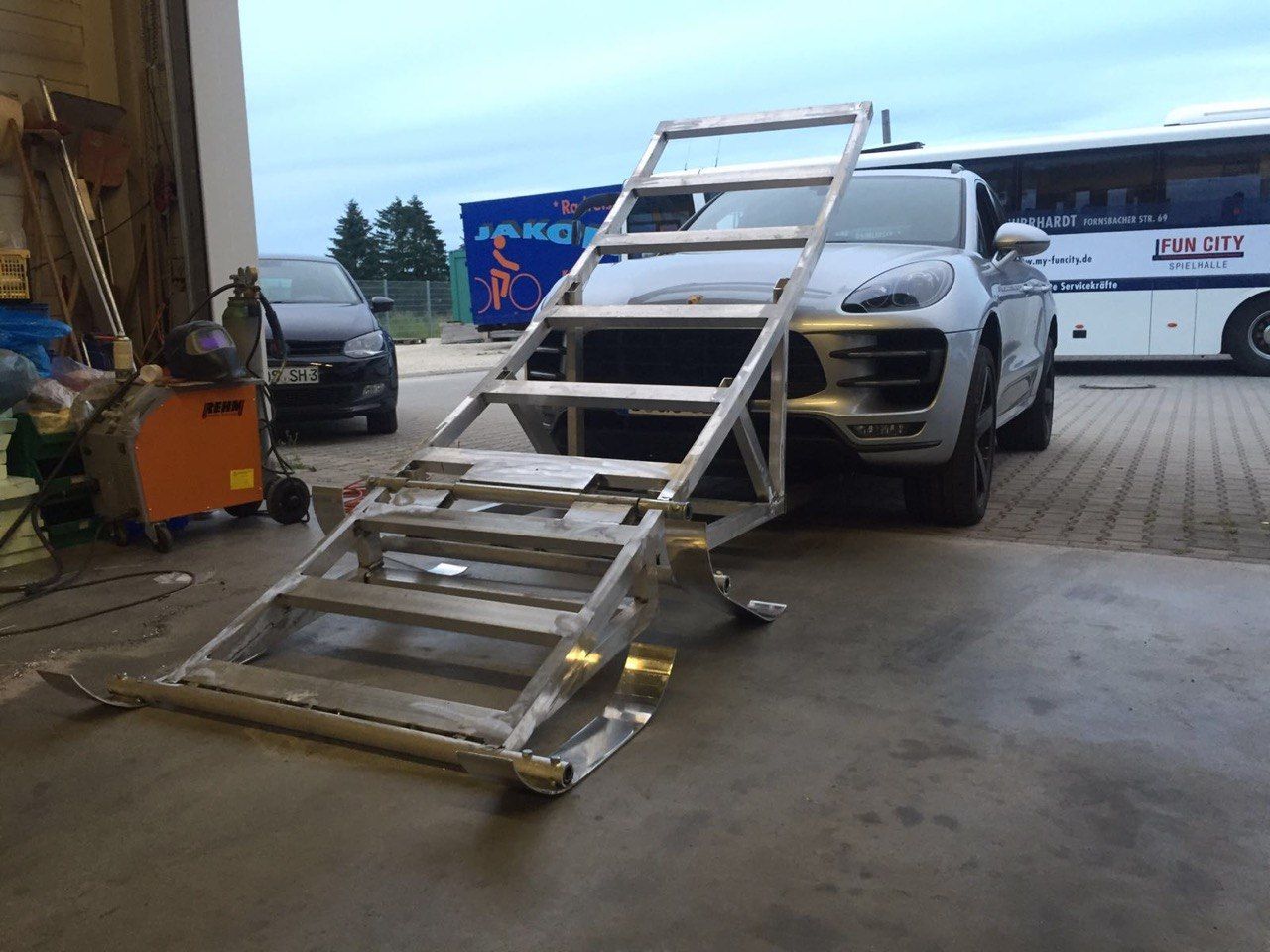
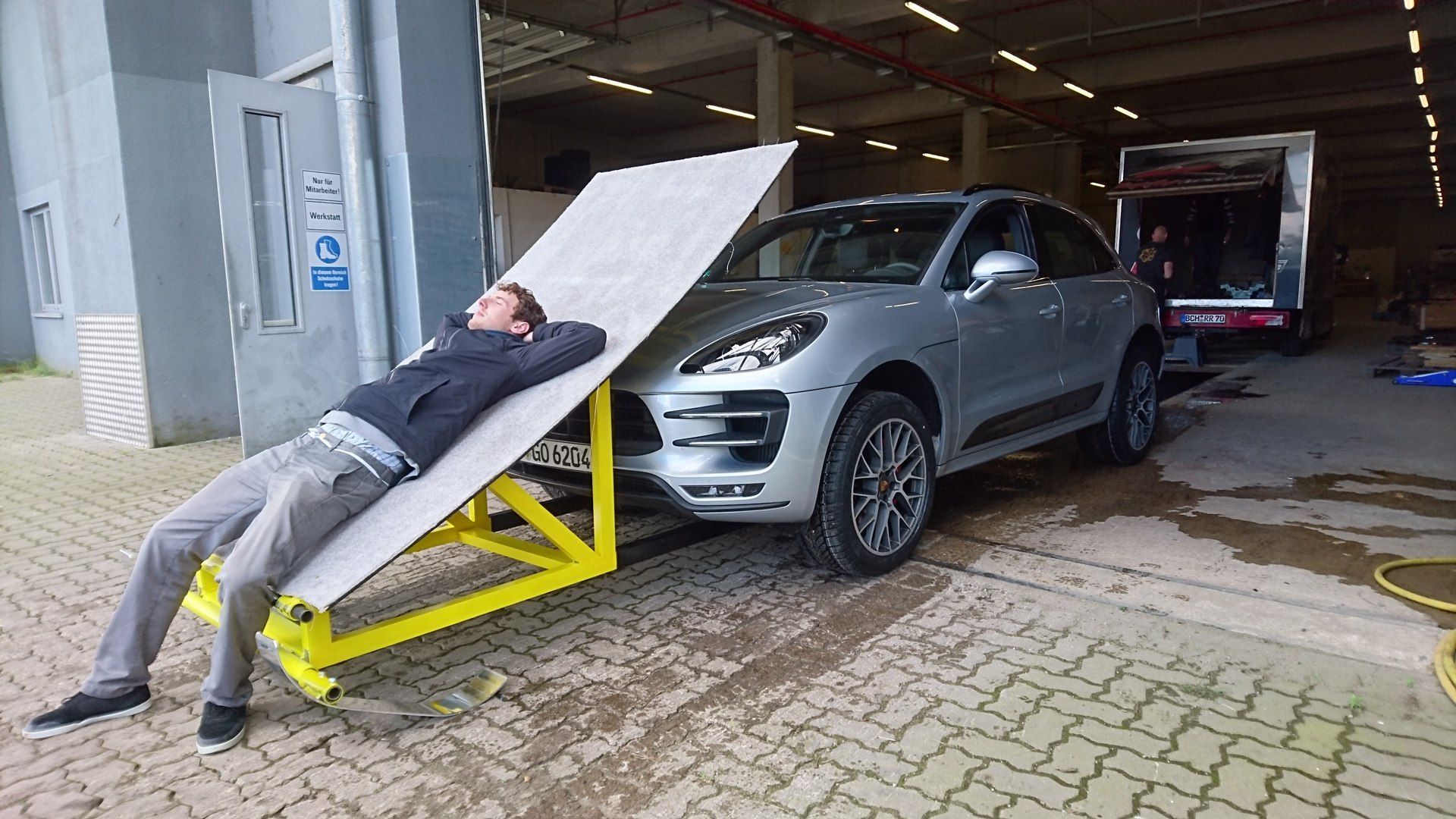
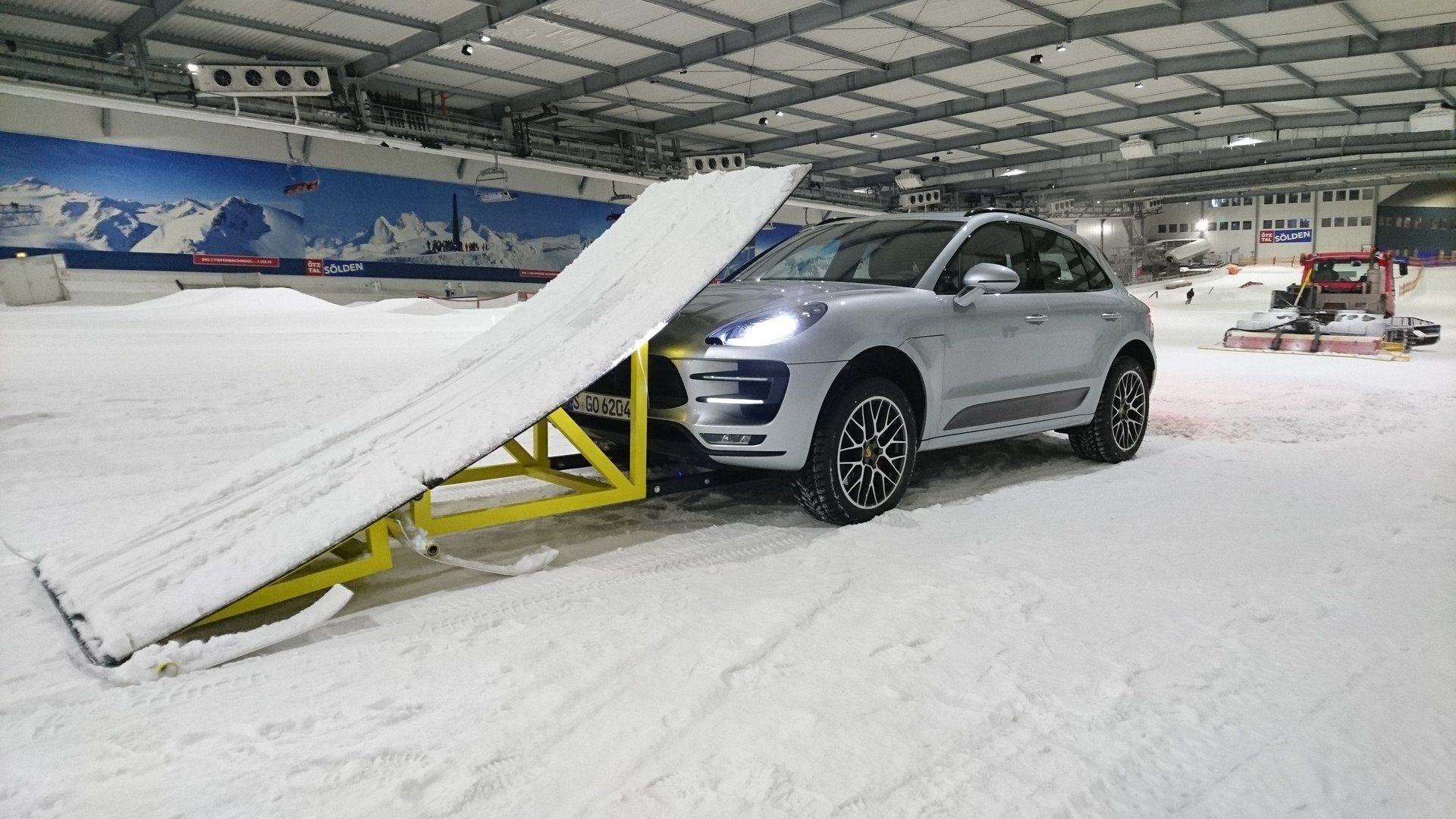
The surviving photographs show that progression: the floor drawing, the open structure in front of the Macan, the completed ramp and the vehicle on the snow.
The central feature of my design was the articulated front section. Even a prepared slope has an uneven surface. The ramp structure was fixed to the vehicle at bumper height, while a hinged entry section with side skids could follow the snow within its intended range of movement.
The entry needed to maintain contact with the surface while preserving the ramp profile required for the jump. I wanted to prevent a ski tip from entering underneath the ramp. The transition from snow to ramp was therefore a fundamental part of the design.
The construction also had to serve the advertising image. The tyres needed to remain visible. Technical function and product presentation were already connected at the design stage: the ramp had to enable the stunt and work for the camera.
Preparation is part of the creative work
Before the shoot, we prepared the vehicle, built and tested the ramp, and developed the working sequence with production. That included assembling my team, scouting the location and rehearsing on site.
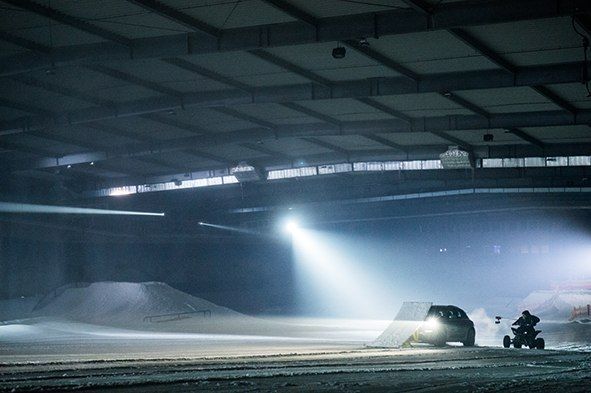
A short rehearsal clip shows a straight jump over the vehicle under work lights. The finished campaign presents the same underlying idea as a carefully composed piece of vehicle action. Between those two images sits the work of developing, preparing, coordinating and executing the stunt for the camera.
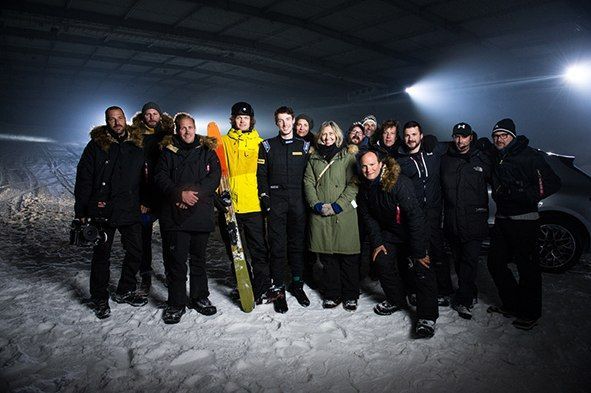
My team brought the required skills together. Joe built the ramp to my design. Dirk Spaniol worked on the mechanics, looked after the vehicle and drove the camera quad. Felix von Sparr supported the mechanical work and ramp checks. Daniel drove the Macan; Torge performed the ski stunt.
I coordinated that work and connected it with production and the filming process. Preparation directly shaped the movement we could create in front of the camera.
Rehearsal — Straight Jump
Moving with the action — an early Warp Drive
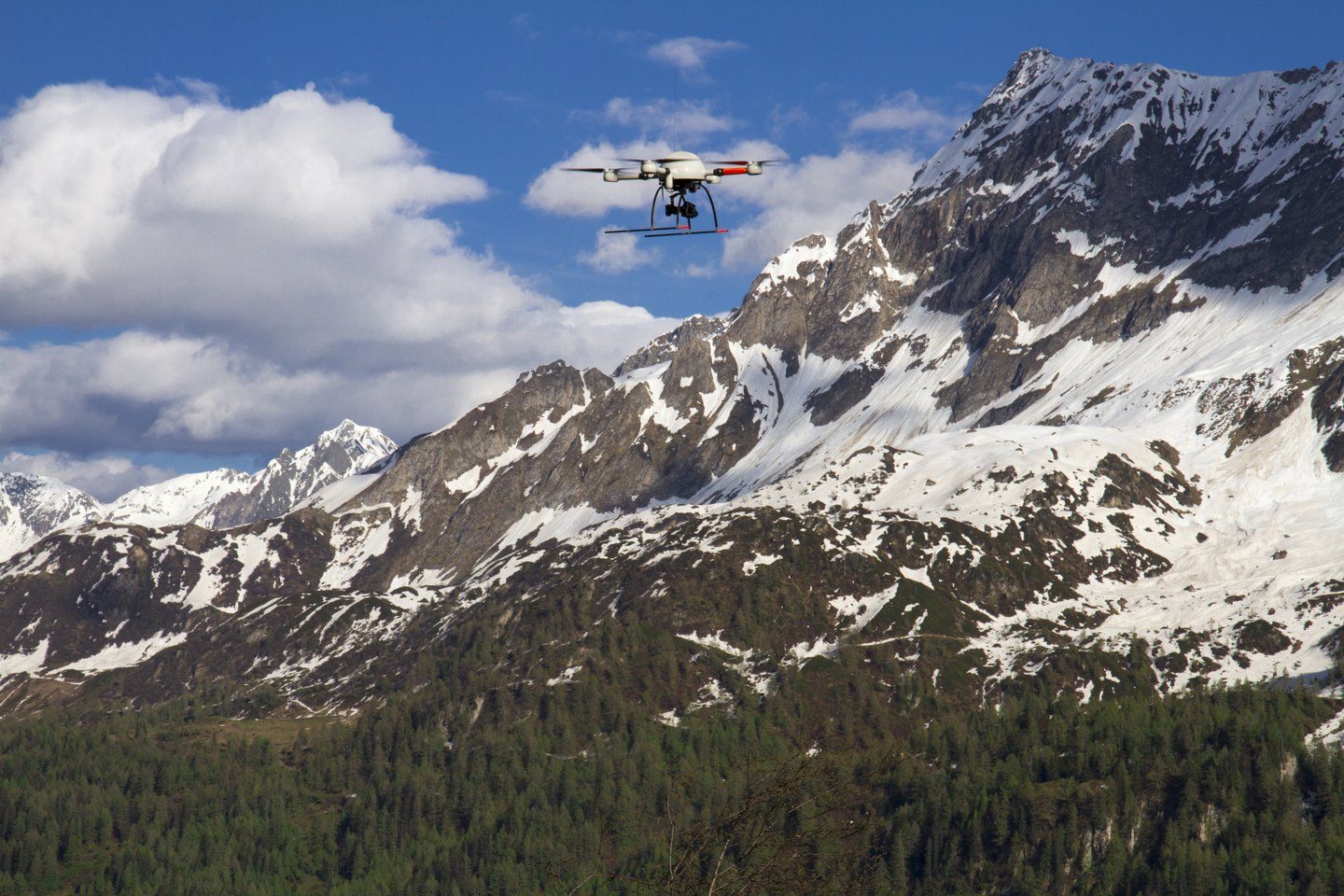
The moving shots were another part of my contribution. My team and I supplied the WarpCam® technology, the operators and the practical execution. I also operated the camera myself.
On the quad, we used an early development stage of what would later become Warp Drive. It was still an early system, but it already allowed us to travel with the skier and vehicles and develop perspectives from within the movement.
We filmed leading shots ahead of the skier, moving close-ups, parallel shots and counter-shots. The camera could accompany the approach, stay close to the performer and make the relationship between the skier and vehicle readable from different directions.
Pascal Rémond was the campaign’s DOP. The static perspectives and long-lens shots were part of his cinematography. My contribution described here concerns the moving WarpCam® images, the camera technology and its operation with my team.
Those responsibilities worked together. I understood the movement we had prepared for the stunt, provided the camera platform and helped execute the moving images. Stunt design and camera movement were developed in relation to each other.
WarpCam® — Moving Camera Work
The decision at the entry lip
This project also included a moment when technical reasoning, performer confidence and the decision on set came into direct contact.
I had designed the front lip to run very close to the snow. Its purpose was to keep the transition onto the ramp as continuous as possible. On the actual slope, it occasionally scraped a little snow from the surface. That was part of the intended design: the contact showed that the entry remained against the ground where the ski tips would meet the ramp.
The skier was uncomfortable with that scraping and wanted more clearance beneath the front lip.
I explained why I had designed the entry that way. A larger gap increased the exact risk I wanted to avoid: a ski tip entering underneath the ramp. I explicitly warned him about that possibility.
As a stunt performer myself, I had always wanted my confidence in the execution to be taken seriously. That experience informs how I work with performers. In this specific situation, I allowed his preference to determine the change. We shortened the front lip.
On the first attempt after that modification, one of his skis went underneath the ramp. He struck the ramp and fell sideways over the vehicle. It was a heavy-looking fall. He was uninjured.
It was precisely the sequence my original design was intended to prevent, and the one I had warned about. The attention to ground contact was part of the preparation that could have prevented that fall.
The skier acknowledged the connection afterwards and apologised. The backflip succeeded on the second attempt without a problem.
That decision belongs in the story. I had designed the ramp and identified the risk introduced by the change. I had also allowed the performer’s preference to alter that part of the execution. The tension between a technical concept, experience and trust shows how demanding a stunt coordinator’s decisions on set can be.
The event on set and the story in the campaign
The real setback later became part of the making-of’s dramatic structure. The attempt appeared to fail. The performer returned. The jump succeeded.
That created the story of an athlete who falls, tries again and completes the challenge. A campaign shapes events into a narrative. We work in show business: creating images, emotion and illusion is part of the job.
In retrospect, the campaign’s story probably benefited from that real setback. The fall was not planned or staged. Its later dramatic value does not change the decision that preceded it.
This case study therefore shows both the image created for the campaign and the work behind it: design, preparation, team coordination and the actual decision-making on set.
Where the disciplines meet
Dunlop is a clear example of how much creative work can sit within a stunt-coordination credit.
That scope was rarely discussed at the time. Commercials often have no detailed end credits that make each contribution visible. Looking at the actual responsibilities behind the booked role helps explain what the production received.
I developed the physical sequence and ramp design, proposed suitable vehicles and selected the skier. I assembled my team, prepared the execution with production and led it on location. We also supplied the WarpCam® technology and moving camera work, including my own camera operation.
Kit Lynch-Robinson directed the commercial. Pascal Rémond led the cinematography. My creative decisions took place within stunt coordination and the moving-camera work.
Developing a performer’s movement for a particular image is a creative decision. Connecting a camera move with that movement involves staging. Designing the construction and supplying the camera technology add further creative and technical responsibilities. On Dunlop, those tasks came together in my work as the creative stunt coordinator.
For production, that meant a connected contribution from the first feasibility question to the filmed result: design, team, technology, preparation and execution.
The finished jump lasts a moment. Its design starts long before it.
Behind the scenes and interviews
Making-of — Dunlop Ski Jump
On Set — Ramp and Vehicle
Interview with Daniel Leavitt — Precision Driver
Interview with Torge Nagel — Skier
Ferdi Fischer’s Stunt Team / SlamArtist.com
- Ferdi Fischer
- Stunt Coordination; Creative Stunt Design; Ramp Concept and Design; Team Leadership; WarpCam® Camera Operation.
- Daniel Leavitt
- Precision Driving.
- Torge Nagel
- Ski Stunt.
- Joachim “Joe” Bauer and workshop team
- Ramp Fabrication and Construction to Ferdi Fischer’s Design.
- Dirk Spaniol
- Mechanics; Vehicle Preparation and Care; Camera Quad Driver.
- Felix von Sparr
- Mechanics and Ramp Checks.
- Ferdi Fischer / SlamArtist.com team
- WarpCam® Technology and Moving Camera Unit.
Production, Direction and Cinematography
- Brand
- Dunlop.
- Agency
- Leo Burnett.
- Production
- Clip Up Film / clip up GmbH.
- Director
- Kit Lynch-Robinson.
- Director of Photography
- Pascal Rémond.
- 2nd Unit DOP
- Stefan Tauber.
- Making-of
- Manuel Prammer.
- 1st Assistant Director
- Marc Bierer.
- Executive Producer
- Marko Savnik.
- Creative Producer
- Markus Seilern und Aspang.
- Line Producer
- Klaus Forsthuber.
- Junior Producer
- Lukas Frech.
- Offline Editor, 90-second version
- Myles Painter.
- Set Photographer
- Tom Maurer.
- Location
- Snow Dome Bispingen.
Additional production crew
- 1st AC
- Phil Petry.
- 2nd AC
- Timmi Davis.
- DIT
- Thomas Stührk.
- Video Operator
- Mario Krohnfuss.
- Gaffer
- Ralph Lütgens.
- Best Boy
- Jörg Willam.
- Lighting Crew
- Claus Fliege, Gerd Spychalski, Sven Strickert.
- Rigging
- Mario Matic.
- Sound
- Benedikt Gaußling.
- Styling / Make-up
- Fidan Baran.
- Production Assistants
- Oliver Sturm, Peggy Windhösel.
- EB Editorial
- Karin Kramer.
- EB Camera Team
- Jannis Anderson, Malte Körte.