Director & Editor: Ferdi Fischer
An autonomous world-record flight, told as a cinematic mission.
Ferdi Fischer directed and edited the Microdrones Alps Crossing campaign, shaping its film concept, hiring and directing the camera team, building the final narrative and coordinating the VFX.

The film
Turning a record attempt into a story
The brief was established: a Microdrones md4-1000 would cross the Gotthard Pass autonomously, without pilot intervention. Ferdi’s task was to turn that achievement into a story that could engage an audience beyond a technical presentation.
He developed the film as a tactical PR and advertising short: a real mission with preparation, execution and a successful conclusion. Communications, a vehicle convoy and an accompanying helicopter became essential parts of a narrative that showed both the technology and the people behind it.
The film was conceived for YouTube, other platforms, websites and trade shows. It needed to make Microdrones’ capabilities tangible while working as a film in its own right.
Autonomous flight, with people ready to intervene
The record flight was autonomous. Four pilots were simultaneously on standby, each able to intervene at any time: one in the accompanying helicopter, one in the road convoy, one at the launch site and one at the landing site. This arrangement formed part of the conditions of the special permit issued for the flight.
The ground operation became part of the story. An open-top car in the convoy maintained a view of the drone, apart from brief tunnel sections. Radio communication, movement and the different viewpoints gave the audience a way to follow the mission.
Ferdi combined these real operations with a deliberately shaped visual language. The tension came from the event itself; the direction made it readable on screen.


Directing an event that could not simply be repeated
The central challenge was uncertainty. There was effectively one opportunity to capture the actual record attempt. The team could not know everything that would happen, but the essential images and human reactions still had to be recorded.
Ferdi developed at least three complete filming approaches in advance. They allowed him to adapt the direction and coverage to the event as it unfolded. His camera operators were also positioned along the route to capture wide shots, establishing views and different perspectives.
The direction had to account for the live operation, the camera team and the finished film at the same time. The aim was to remain responsive while preserving a coherent story.


Documentary reality with the visual language of cinema
Slow-motion helicopter shots, low angles, dynamic vehicle photography, aerial images and the scale of the Alps define the film. They give the technical achievement a physical presence: altitude, distance, movement and the relationship between the drone, vehicles and landscape become tangible.
Ferdi approached the documentary production with the visual ambition of a feature film. Aesthetics carried the same weight as narrative. That approach was not standard for this type of production in 2013; it is now familiar in ambitious contemporary documentaries.
Additional aerial inserts of the vehicles were filmed the following day. They complemented the footage captured during the record attempt and gave the edit a more deliberate visual rhythm.


A camera team hired and directed by Ferdi Fischer
Ferdi assembled the camera team and led it as the film’s director. Ulrik Bruchholz served as DOP and Camera Operator. The camera operators hired by Ferdi also included Jonathan Heidrich, Andreas Nguyen (Andy Long), Vi-Dan Tran, Shawn Bu and Stipe Braun.
All six worked under Ferdi’s direction to realise the film. Ferdi also operated a camera himself. The different positions and perspectives served one shared film concept.


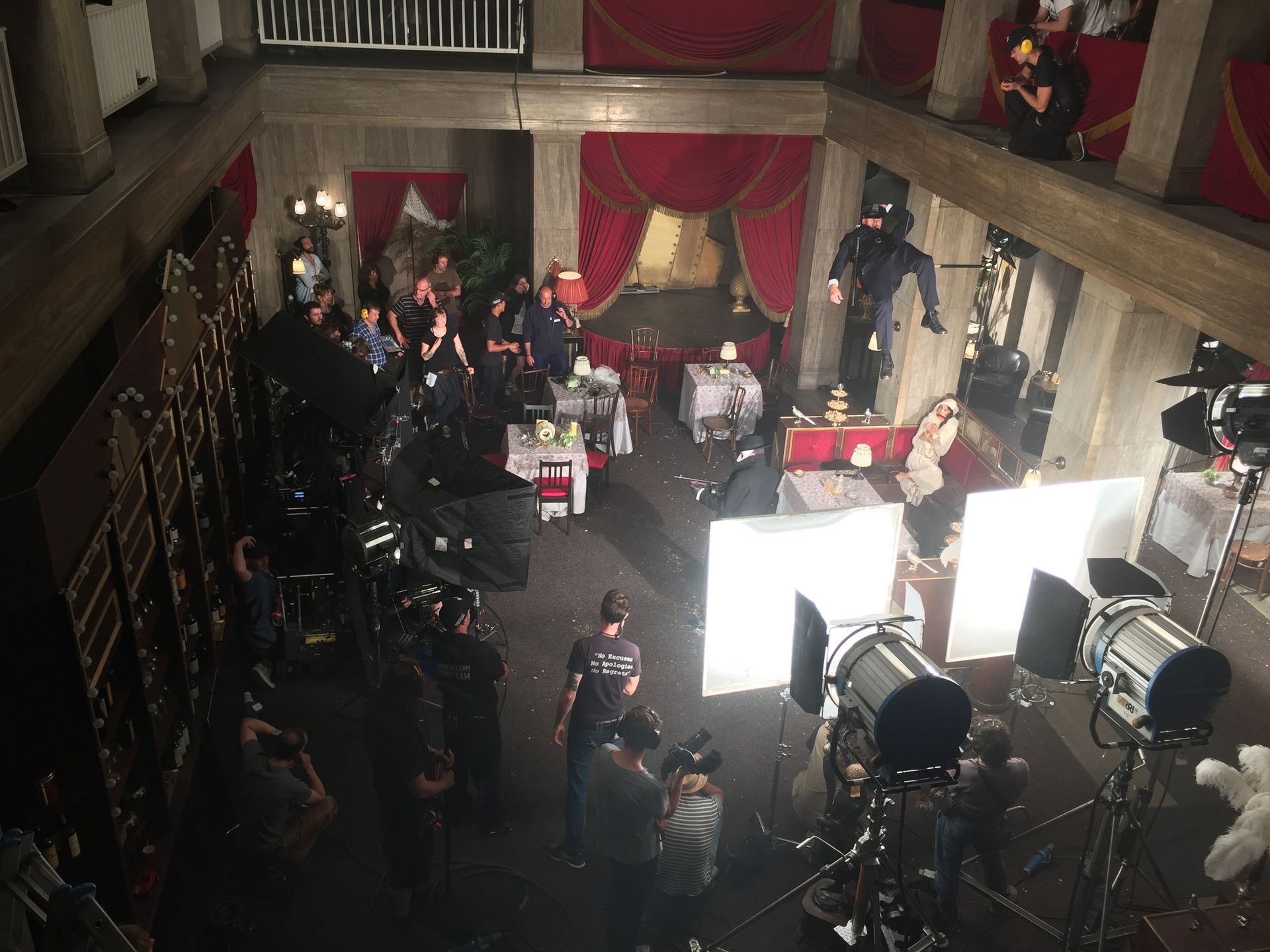
Behind the scenes
Why the direction continued in the edit
Editing was included in the complete package agreed with Microdrones from the outset. The client knew Ferdi’s work and valued his modern, tactical editing style. The combination of documentary storytelling, Hollywood staging and strong imagery was intended to run through the entire film.
For Ferdi, the edit was also a continuation of the direction. Being present during the event meant knowing where the real tension lay, which problems had emerged and why a particular reaction mattered. That knowledge informed the placement of each image.
A glance, a pause or a team member’s reaction gains meaning from its actual context. Placing those moments in the right dramatic sequence preserves the tension of the production in the finished film. Ferdi committed the time to shaping that edit himself.
The VFX and graphic overlays were integrated into the same narrative. Ferdi coordinated their execution and integration, with the 3D titles created by Gunnar Heiss. Location titles and designed displays complemented the images and helped the audience follow the mission.


A film that led directly to the next commission
The campaign became a major success and immediately led to a follow-up commission from DHL.
Alps Crossing demonstrates Ferdi’s work as the overall director: developing the film concept, assembling and directing the camera team, filming a real event, editing the story and coordinating its visual completion. One continuous directorial process, from the initial film idea to the finished result.
Film credits

- Director & Editor
- Ferdi Fischer
- Film concept, camera-team direction, VFX coordination
- Ferdi Fischer
- Production
- Microdrones GmbH / Microdrones Pictures
The camera team was hired by Ferdi Fischer and worked under his direction.
- DOP & Camera Operator
- Ulrik Bruchholz
- Camera Operator
- Jonathan Heidrich
- Camera Operator
- Andreas Nguyen (Andy Long)
- Camera Operator
- Vi-Dan Tran
- Camera Operator
- Shawn Bu
- Camera Operator
- Stipe Braun
- Additional camera operation
- Ferdi Fischer
- 3D Titles
- Gunnar Heiss
- Precision Drivers
- Daniel Evans Leavitt · Ferdi Fischer
- Additional Drone Footage
- Ferdi Fischer · Daniel Evans Leavitt
- Timelapse
- Ulrik Bruchholz
- Microdrones team
- Sven Juerss · Maik Halbe · Elmar Prinz · Johannes Schroeder · Martin Kreck · Emil Siegrist
Coverage
- Microdrones
Unmanned Microdrones UAV crosses the Alps
Microdrones names Ferdi Fischer as director and describes the flight over the Gotthard massif.
- IEEE Spectrum
Video Friday: Crossing the Alps, DRC Robots, and Kirobo Goes to Space
The engineering magazine featured the crossing in its weekly video column.
- R&D World
Video: First microdrone crosses the Alps
The report introduces footage from the crossing and lists the flight data.
- GPS World
Microdrone Navigates over the Alps with u-blox GPS
The article explains how the GPS receiver supported autonomous navigation.
- Tagesspiegel
Drohnen in Europa: Bambi retten, Flüchtlinge jagen
A report on drones in Europe mentions the md4-1000’s crossing of the Alps.
- WELT
DHL testet erstmals Paketlieferung per Drohne
WELT’s report on the DHL parcel drone recalls the earlier autonomous flight across an Alpine pass.
More coverage
- Unmanned Systems Technology
Video: Microdrones md4-1000 Alps Crossing
The industry publication features the making-of film about the crossing.
- UAS Vision
Unmanned QuadCopter Crosses the Alps
A contemporary report on the md4-1000’s route across the Alps.
- MaschinenMarkt
Miniatur-Drone gelingt Alpen-Überquerung
The Swiss trade publication covers the technical aspects of the crossing.
- MFI
Rekord-Härtetest: Unbemannter Quadrocopter überquert die Alpen
The model aviation magazine reports on the quadcopter’s record flight.
- mebucom
Rekordflug einer Video-Drohne
The broadcast technology publication reports on the camera drone’s flight.
- DronEzine
Un drone effettua un passaggio sulle Alpi
The Italian article discusses the footage and the support provided by the cars and helicopter.
- VICE / Motherboard
Drohnen über Deutschland
The article on drones in Germany also examines the tactical visual language of the film.
- u-blox
Annual Report 2013
On printed page 37, the annual report identifies the crossing as an application of u-blox GPS technology.
- Microdrones
Why surveyors should care about this stuntman’s experience with drones
In this 2016 interview, Ferdi Fischer discusses working with drones on location.
- DroneBelow
An Interview with Mike Dziok, Marketing Director at Microdrones
Marketing director Mike Dziok explains what customers could learn from watching the flight.
- Investment Plattform China/Deutschland
Unbemannte Luftfahrzeuge
Norbert Hofmann’s article on Microdrones includes a photograph of the Alpine crossing on page 24.